
TL;DR: Yellow fever vaccine requirements by country are set by individual governments under the International Health Regulations, and the strictest rules are concentrated in Africa and South America. Your final destination isn't the only thing that matters. Your full itinerary, including airport transit and layovers, can trigger a requirement, and the proof used at the border is the International Certificate of Vaccination or Prophylaxis (ICVP).
You may be booking a trip to Ghana, Brazil, or Kenya and assuming the only question is whether yellow fever vaccine is recommended. At the border, that isn't always the question that matters. What matters is whether the country you're entering requires documented proof of vaccination for someone with your exact route of travel.
That catches travelers all the time. A person flying from the U.S. directly to one country may face no issue, while another traveler on the same trip purpose, but with a long layover in a yellow fever risk country, may be asked for a yellow card on arrival. In travel medicine, the itinerary matters as much as the destination.
Table of Contents
- Your Essential Guide to Yellow Fever Vaccine Rules
- The Public Health Reasons Behind Vaccination Rules
- Understanding Your Proof of Vaccination The ICVP
- Countries That Require Vaccination from All Travelers
- Navigating Conditional Vaccination Requirements
- The Critical Guide to Transit and Layover Rules
- Vaccine Validity Lifetime Immunity vs Outdated Rules
- How to Get Your Yellow Fever Vaccine in Maryland
- Frequently Asked Questions About Yellow Fever Vaccination
Your Essential Guide to Yellow Fever Vaccine Rules
If you're planning international travel, start with one rule: check the entry requirement for every country on your itinerary, not just the one where you'll sleep that night. Yellow fever vaccine requirements by country aren't uniform. One country may require proof from all arriving travelers above a certain age, while another only asks for it if you recently came from a yellow fever risk country.
The required proof is the ICVP, often called the yellow card. Without it, a traveler may face delays, extra screening, or a boarding problem before the trip even begins. That's why yellow fever planning belongs on the same checklist as visas, medications, and passport validity.
A good pre-travel workflow includes your flights, layovers, timing, and vaccination records. If you're organizing the bigger picture, this guide on how to prepare for international travel is useful because it helps travelers line up documents and timing before departure. For country-specific vaccine planning, it also helps to review broader immunizations required for international travel so yellow fever isn't handled in isolation from the rest of the trip.
Three rules that prevent most problems
- Check the full route: Include transit airports and long layovers.
- Check timing early: The vaccine certificate doesn't become valid immediately.
- Carry the document properly: Border officials usually want the official certificate, not just a clinic receipt.
Practical rule: If your itinerary has more than one flight segment, assume you need to verify yellow fever requirements for each stop until proven otherwise.
The Public Health Reasons Behind Vaccination Rules
These rules exist to stop importation of yellow fever virus into places that want to prevent local transmission. Countries apply those rules under the International Health Regulations (IHR) framework, which gives governments room to set border measures aimed at reducing disease spread.
That framework matters because yellow fever isn't only an individual risk. It becomes a border-control issue when infected travelers can carry the virus into places with competent mosquito vectors and conditions that allow transmission. That is why a country may enforce a rule even if the traveler feels well.
Why so many rules cluster in Africa and South America
The practical map of yellow fever requirements follows disease risk. The CDC's Yellow Book notes that yellow fever vaccination requirements operate under the IHR, and it reports that between 2018 and 2024, the WHO International Coordinating Group approved 33,851,072 doses of yellow fever vaccine for deployment across Africa alone (CDC Yellow Book yellow fever guidance). That scale tells you these rules aren't bureaucratic leftovers. They sit on top of active public health programs.
Countries in Africa and South America show up repeatedly in yellow fever travel planning because that's where governments are balancing inbound travel against ongoing transmission risk patterns. For travelers, that means the rules often make more sense when you view them as outbreak prevention, not paperwork.
What works for travelers
The most reliable approach is to treat yellow fever review like a clinical risk assessment, not a quick web search.
- Use the government rule, not a travel forum: Countries can set their own entry mandates.
- Review the exact route: Border requirements may depend on where you've been recently, not only on citizenship or passport.
- Plan before tickets become nonrefundable: Vaccine timing can affect whether a trip remains feasible.
Border health officers aren't judging whether your itinerary seems reasonable. They're checking whether your documents meet their country's entry standard.
Understanding Your Proof of Vaccination The ICVP
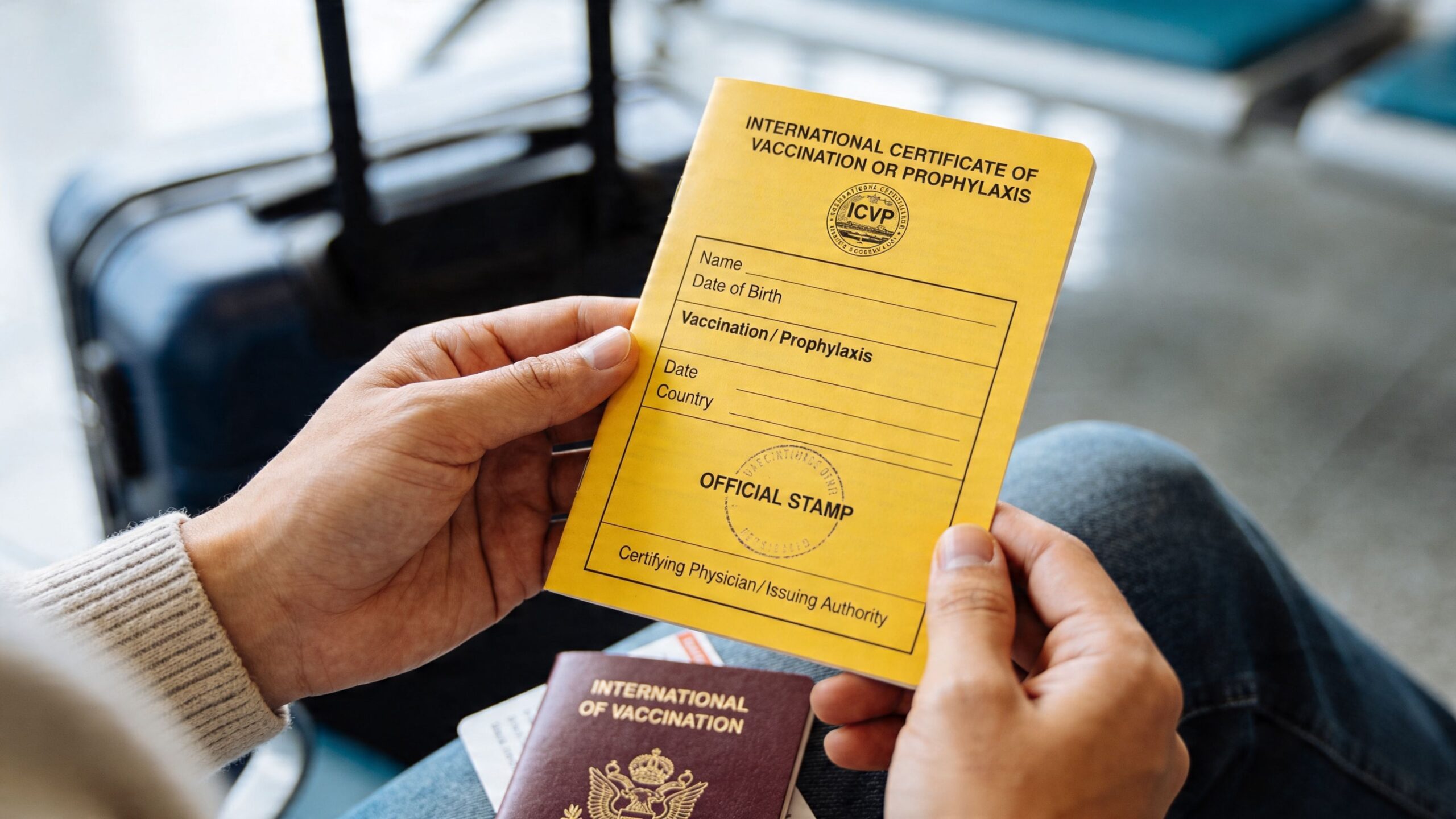
The document that matters at the airport and border is the International Certificate of Vaccination or Prophylaxis, or ICVP. Patients usually call it the yellow card. In practice, it serves one purpose: it gives immigration and health authorities a standardized record that you received yellow fever vaccination in a way recognized under international rules.
A screenshot of an electronic health record, a pharmacy handout, or a message in your patient portal usually won't serve the same function. Travelers often assume any vaccine proof is enough. For yellow fever, that assumption causes trouble.
For a broader overview of how travel shots are scheduled and documented, this primer on travel vaccinations before your next trip is a useful companion.
What the yellow card does
Under the International Health Regulations, proof of vaccination is provided through the ICVP. Africa CDC states that the certificate becomes valid 10 days after a single dose and, after the 2016 IHR amendment, is considered valid for the life of the traveler (Africa CDC yellow fever guidance).
Those two points shape real travel decisions:
- If you get vaccinated too close to departure, the certificate may not yet be valid for entry.
- If you were vaccinated years ago and still have a valid certificate, your immunity documentation may still stand even if someone tells you yellow fever always expires after a decade.
What makes the certificate valid
The clinic must complete the ICVP correctly. Travelers should inspect it before leaving the appointment.
Check for these basics:
- Your identifying details: They should match your travel documents.
- Vaccination entry: The yellow fever vaccine should be clearly documented.
- Authorized completion: The form needs to be issued by a provider authorized to give yellow fever vaccine and complete the certificate.
- Date awareness: Your arrival must be at least 10 days after vaccination for entry validity.
A practical mistake I see is simple. Patients protect the passport but fold, misplace, or forget the yellow card. Keep it with the passport from the day it's issued.
Bring the ICVP in your carry-on, not your checked luggage. If an airline agent asks before boarding, your bag won't help you.
Countries That Require Vaccination from All Travelers
Some countries apply a broad rule and require yellow fever vaccination proof from nearly all incoming travelers above the stated age threshold. This is the easier category to understand because the answer doesn't depend as much on where you were before arrival. If the country's rule is universal, officials are looking for the certificate because that's their baseline entry standard.
The broader geography follows disease risk. A large share of these strict rules are found in Africa, and several South American destinations maintain strong yellow fever controls as well. Epidemiologic analysis also reflects that pattern, with countries such as Ghana, Nigeria, and Kenya in Africa and Brazil, Bolivia, and Peru in South America maintaining vaccination mandates tied to transmission risk (epidemiologic review of yellow fever vaccination patterns).
Universal requirement means the destination sets a blanket rule
This category is common in travel medicine conversations because it's the least forgiving. If a traveler is headed to a country with a blanket rule, there usually isn't much value in debating whether the trip is urban, short, or business-related. The only question is whether the traveler has valid proof.
Examples identified in WHO and Africa CDC country lists include countries such as:
- Benin
- Burkina Faso
- Burundi
- Cameroon
- Central African Republic
- Congo
- Côte d’Ivoire
- Democratic Republic of Congo
- Gabon
- Guinea-Bissau
- Kenya
- Liberia
- Niger
- Rwanda
- Sierra Leone
- Togo
Travelers often focus only on health documents and forget that border compliance is a package. If you're also sorting flight logistics and immigration paperwork, a separate tool for proof of onward travel can help you review another document that airlines and border officials may ask for.
Sample country table
| Country | Minimum Age for Requirement | Official Source Notes |
|---|---|---|
| Benin | Usually travelers aged 9 months or older | Listed among countries with unconditional yellow fever vaccination requirements under IHR-based country rules |
| Burkina Faso | Usually travelers aged 9 months or older | Universal requirement applies regardless of origin |
| Cameroon | Usually travelers aged 9 months or older | Commonly enforced as a blanket entry requirement |
| Democratic Republic of Congo | Usually travelers aged 9 months or older | Broad proof requirement tied to high transmission concern |
| Kenya | Usually travelers aged 9 months or older or 1 year old depending on country protocol wording | Treated as a destination where proof may be required from all travelers under country rules |
| Rwanda | Usually travelers aged 9 months or older | Frequently appears in universal-requirement lists |
| Sierra Leone | Usually travelers aged 9 months or older | Rule applies at entry rather than only from risk-country arrivals |
| Togo | Usually travelers aged 9 months or older | Travelers should expect routine certificate review |
If your destination sits in the universal category, don't rely on airline staff to catch the issue for you early. Some do. Some don't.
Navigating Conditional Vaccination Requirements
Conditional requirements are where yellow fever vaccine requirements by country become harder to interpret. In this model, a country doesn't ask every traveler for proof. It asks only if your route places you in a defined risk scenario, usually because you're arriving from or recently transited through a country with risk of yellow fever transmission.
This is why two travelers can land in the same airport on the same day and face different document checks. The difference isn't their purpose of travel. It's where they were before arrival.
When the rule is based on where you were before arrival
A country using a conditional rule is trying to block importation from yellow fever risk areas without imposing a blanket requirement on everyone. That means the decision point is often one of these:
- Departure from a risk country
- Recent stay in a risk country
- Transit through a risk country under that destination's transit threshold
- Age threshold for the traveler
Examples in the verified data include countries such as Ethiopia and Honduras, which may require proof from travelers arriving from endemic regions or sub-Saharan Africa. Many other countries use similar logic.
How to think through a conditional rule
Use this sequence:
- Start with your final destination. Check whether it has a conditional yellow fever rule rather than a universal one.
- Map the route backwards. Look at every place you depart from or pass through before landing there.
- Ask whether any stop is considered a yellow fever risk country.
- Check whether the destination applies the rule to transit, not just formal entry.
A simple way to think about it is this:
| Scenario | Likely result |
|---|---|
| U.S. traveler flying directly to a country with a conditional rule, no stop in a risk country | Proof may not be required |
| U.S. traveler flying to the same destination after travel through a yellow fever risk country | Proof may be required |
| Traveler with multi-country itinerary inside Africa or South America | Requirement risk increases and needs close review |
What doesn't work is assuming the rule follows your passport nationality. It usually doesn't. Border authorities care more about your recent epidemiologic exposure route than your citizenship.
One more point matters in practice. Conditional rules become much more important when travelers build trips in stages. A person may begin in the U.S. with no requirement, then add regional travel later and unexpectedly trigger one for onward entry. That is where many last-minute problems start.
The Critical Guide to Transit and Layover Rules
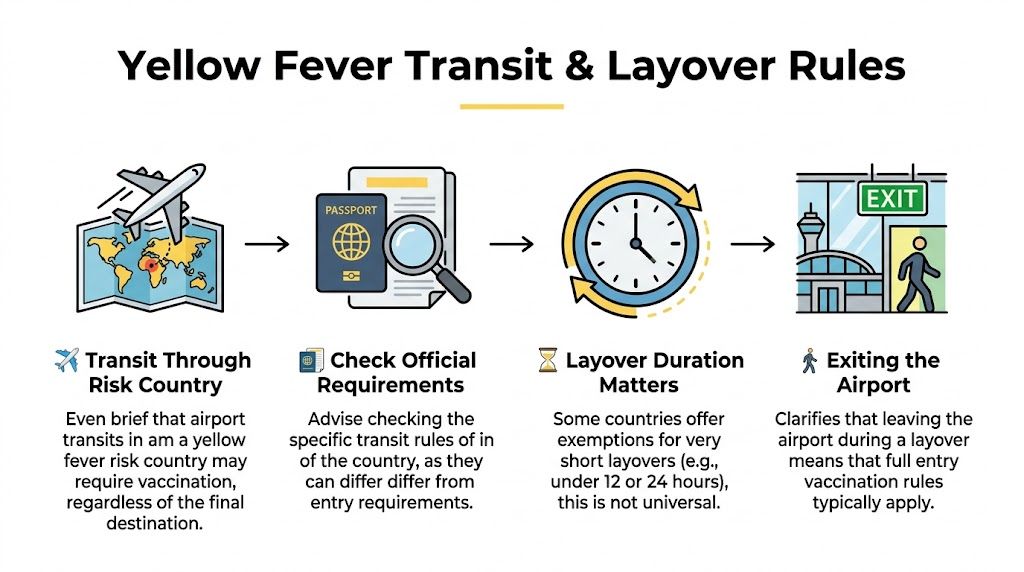
Transit rules cause more confusion than almost any other part of yellow fever travel planning. Many travelers think, "I never left the airport, so it doesn't count." Sometimes that's true. Sometimes it isn't. The destination country's rule controls, and some countries count longer airport transit through a yellow fever risk country as enough to trigger proof requirements.
Verified data indicates that many countries, including China, Australia, and Egypt, require proof of vaccination for travelers transiting for more than 12 hours through an airport in a country with risk of yellow fever transmission, and WHO data from 2022 confirms over 30 countries have such transit rules in place (Passport Health yellow fever vaccination overview).
Why transit causes so much confusion
Transit rules fail travelers for three reasons.
First, the traveler reads only the destination country's "entry" rule and misses the separate transit clause. Second, airline itineraries can change after booking, turning a short connection into a long one. Third, people assume layovers in one region are interchangeable, when only some locations trigger yellow fever concerns.
A layover isn't medically important because you touched an airport seat. It's legally important because the destination may classify that transit as exposure risk for importation control.
A practical way to review your flights
Use a document check, not a memory check.
- Print or save the full itinerary: Include airport codes, stop lengths, and overnight connections.
- Flag any stop in a yellow fever risk country: That's the trigger point to investigate.
- Look for the transit threshold: Many countries use more than 12 hours, but not all rules are identical.
- Check whether you're exiting the airport: Once you enter the country during a layover, full entry rules may apply.
- Recheck after schedule changes: Airlines can move you into a different routing without warning.
Here are practical examples:
| Itinerary pattern | Risk of certificate requirement |
|---|---|
| U.S. to destination with no stop in a risk country | Lower |
| U.S. to final destination with a long airport transit in a risk country | Higher |
| U.S. to one country, then onward travel within Africa or South America | Higher and often overlooked |
Common mistakes that don't hold up at the airport
Some approaches sound reasonable but fail in practice:
- "I was only in transit." That doesn't help if the destination counts long transit as a trigger.
- "The airline let me board the first flight." Airline screening isn't the final legal authority at arrival.
- "My layover was extended by disruption." Border officers may still apply the rule as written.
- "I have a clinic receipt on my phone." Officials usually want the ICVP.
If your itinerary includes complex hubs, overnight stops, or a multi-country route, ask a travel clinic to review the full booking, not just the destination city.
Vaccine Validity Lifetime Immunity vs Outdated Rules
The yellow fever booster myth persists because two different realities exist at once. The medical and regulatory standard says one thing. Border enforcement sometimes says another.
What the official rule says
WHO and CDC have affirmed in recent years that a single dose provides lifelong immunity for most travelers. That aligns with the IHR position on lifetime validity of the certificate.
For many patients, that means they don't need a routine repeat dose due to the mere passage of time. If they received yellow fever vaccine appropriately and still have valid documentation, the core medical question is often already settled.
What sometimes happens at the border
The problem is inconsistent enforcement. Verified data shows that a significant number of countries, such as Brazil and Bolivia, may still inconsistently enforce a 10-year recency for certificates, which creates confusion and can lead to unnecessary revaccination (WHO country list PDF referenced in verified data).
That doesn't mean travelers should automatically seek another dose. It means they should verify the practical enforcement climate for the exact route and country involved.
A useful distinction:
| Question | Best interpretation |
|---|---|
| Does immunity usually expire after 10 years? | Officially, no for most travelers |
| Can border enforcement still behave as if it does? | Sometimes, yes |
| Should every traveler get revaccinated because of that? | No. Individual review matters |
Clinical judgment matters here. A traveler with a valid old certificate doesn't need reflexive revaccination just because someone online says the border "likes newer paperwork."
What works is early review. If a traveler has an older ICVP, the right move is to bring it to a travel consultation and check the current enforcement pattern for the specific destination. What doesn't work is assuming every border officer applies the latest rule perfectly.
How to Get Your Yellow Fever Vaccine in Maryland

Yellow fever vaccine isn't something to leave for the last week before travel. The appointment needs to happen early enough for the certificate to be useful and for the clinician to review whether the vaccine is appropriate for you.
In Maryland, travelers should book with an authorized yellow fever vaccination center. One local option is yellow fever vaccine near me, where travelers can arrange a visit that includes itinerary review and vaccine documentation.
What to bring to your visit
Bring the details that affect the recommendation:
- Your itinerary: Include all countries, transit airports, and layover durations.
- Departure date: Timing matters for certificate validity.
- Vaccine history: Old records and prior yellow cards are helpful.
- Medical history: Contraindications and precautions matter with a live vaccine.
- Medication list: Especially if you have immune-related conditions or treatment.
If you want a quick walkthrough before your appointment, this short video gives helpful context on travel vaccine planning.
What happens during the appointment
A good travel consultation is more than an injection. The clinician should review your route, identify whether the requirement is universal or conditional, look for transit triggers, and assess whether yellow fever vaccine is medically appropriate.
If the vaccine is given, the next step is completing the ICVP correctly and making sure you understand when it becomes valid for travel. If the vaccine isn't appropriate because of a medical issue, the conversation shifts to waiver documentation and route planning, since not every country handles waivers the same way.
Frequently Asked Questions About Yellow Fever Vaccination
What if I have a medical reason not to get the vaccine
Some travelers can't safely receive yellow fever vaccine. In that situation, an authorized yellow fever vaccine provider may issue a medical waiver. Whether that waiver will be accepted is up to the destination country's authorities, so travelers should check the country rule before departure and carry the waiver with the rest of their travel documents.
What should I do if I lose my yellow card
Contact the clinic that issued the certificate as soon as possible. If the provider has the vaccination record and can verify the original documentation, they may be able to help with replacement or reissuance procedures. Don't wait until the airport to deal with this.
Do children need yellow fever vaccination for travel
Some country rules apply to travelers above a minimum age threshold, often 9 months or 1 year old, depending on the country's protocol. Parents shouldn't assume a child is exempt just because the child is young. The exact destination rule, route, and medical suitability all need review.
Can I rely on the airline to tell me if I need it
No. Airline staff may catch a problem, but they aren't the final source of truth for country health entry rules. Use the airline as one checkpoint, not the only checkpoint.
If I already had the vaccine years ago, should I get another one
Not automatically. Bring your prior certificate to a travel consultation and have the specific destination and itinerary reviewed. The right answer depends on documentation, medical history, and how that country currently applies its entry rule.
If you need help sorting out yellow fever vaccine requirements by country, especially for a route with layovers, regional connections, or an older vaccination record, Maryland Primary and Urgent Care can help you review the itinerary, assess whether vaccination is appropriate, and complete the required travel documentation before departure.