
TL;DR: The specific immunizations required for international travel depend entirely on your destination, but yellow fever is the most common mandatory vaccine. All travelers should check the CDC’s destination-specific guidance at least 4 to 6 weeks before travel so they can meet entry rules and leave enough time for any needed vaccines to work.
You may already have the flights booked, the hotel confirmed, and the passport sitting on the counter. Then the practical questions hit. Do I need any shots? Which ones are legally required, which ones are just advised, and what if I have diabetes, high blood pressure, or take immune-suppressing medication?
That’s where most travelers get stuck. They search for one universal list, but there isn’t one. Travel vaccines depend on the country, your route, your medical history, and sometimes even where you’re transiting. A beach trip, a safari, a family visit, and a business conference can each create different health requirements.
Table of Contents
- Your Pre-Travel Health Checklist
- Required vs Recommended Travel Vaccines Explained
- How to Find Country-Specific Vaccine Requirements
- Your Travel Vaccine Timeline
- Understanding the Yellow Card and Other Vaccine Documentation
- Special Vaccine Considerations for Your Health
- How Our Clinic Supports Your Travel Health Needs
- Frequently Asked Questions About Travel Immunizations
Your Pre-Travel Health Checklist
The first step is simple. Don’t start with the vaccine name. Start with the itinerary. Country, layovers, travel dates, urban versus rural stays, and the purpose of the trip all shape what you may need.
A lot of last-minute travel stress comes from treating vaccines like a single errand instead of part of trip planning. If you’re organizing documents, medications, chargers, and security items already, it helps to treat health prep the same way. A practical packing resource like this ultimate travel guide with planning and packing tips can help you build a complete checklist so health details don’t get separated from the rest of your trip planning.
Start with these five items
Your full itinerary
Include every country you’ll enter, transit through, or visit on a cruise or side trip.Your vaccine history
Bring any prior records you can find. Even partial records are useful.Your medication list
This matters if you take insulin, blood pressure medication, biologics, steroids, or other immune-affecting treatment.Your health conditions
Asthma, heart disease, diabetes, kidney disease, pregnancy, and immune compromise can change the vaccine plan.Your timeline
The earlier you check requirements, the more options you have.
Practical rule: If you don’t know where to start, book the travel health visit as soon as you know your dates. Sorting requirements early is much easier than trying to solve them the week you leave.
If you want a concise overview of why a pre-travel visit matters before you go further, this travel clinic guide before traveling explains the basics well.
Required vs Recommended Travel Vaccines Explained
A common travel problem starts at the airport check-in desk or border counter. A traveler has done their packing, booked the flights, and brought their passport, but the vaccine paperwork is incomplete, or they assumed that if no vaccine was required for entry, they were fully covered. I see this more often in people managing diabetes, heart disease, kidney disease, autoimmune conditions, or treatment-related immune suppression, because their vaccine decisions are rarely as simple as a destination list.
A required vaccine is one a country may ask you to document for entry. A recommended vaccine is advised to lower your risk during the trip based on where you are going, how long you will stay, what you will eat and drink, and what exposures are likely. Routine vaccines are the standard vaccines that should already be up to date before travel begins.
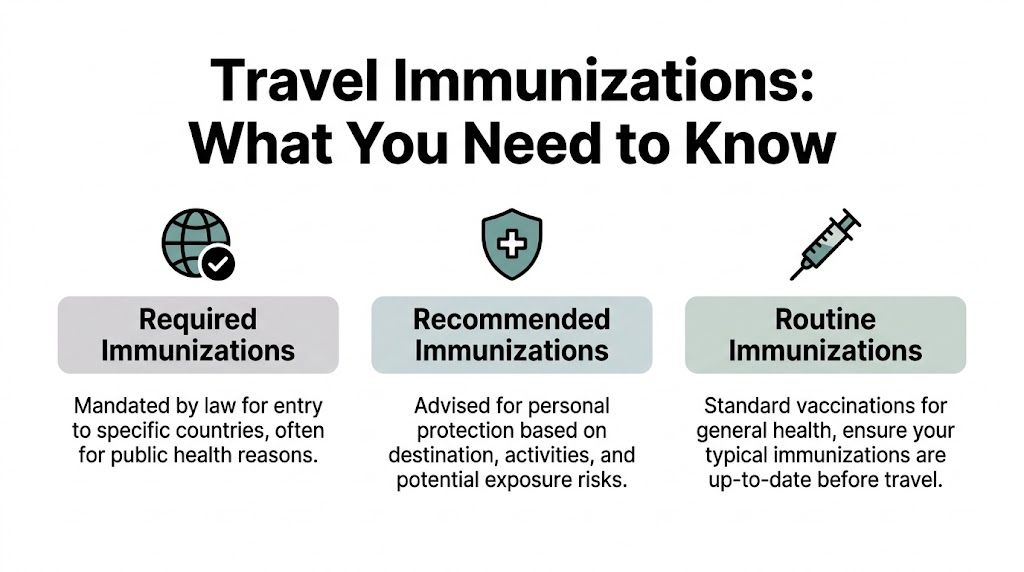
Three categories that matter
The clearest example of a required vaccine is yellow fever. Some countries ask for documented proof of vaccination based on where you are arriving from or where you recently traveled. Border officials are addressing importation risk as well as your individual health.
Recommended vaccines work differently. Immigration may never ask about hepatitis A, typhoid, or hepatitis B, yet those vaccines can make a real difference if your trip involves rural travel, extended stays, higher-risk food and water exposure, medical work, or close contact with local communities. For travelers with chronic medical conditions, the threshold to recommend protection is often lower because dehydration, infection, or even a short illness abroad can disrupt blood sugar control, blood pressure management, dialysis schedules, or access to routine medications.
Routine vaccines deserve more attention than they usually get. Measles, influenza, COVID-19, tetanus, and pertussis still cause avoidable travel problems, especially in airports, group tours, cruises, and multigenerational family trips. If you are immunocompromised, routine vaccines also need a closer review because timing, vaccine type, and expected response may differ from the standard plan.
For a plain-language overview, this travel vaccinations 101 guide explains the basics patients should review before departure.
Categorizing travel vaccines
| Vaccine Category | Purpose | Examples |
|---|---|---|
| Required | Meets entry rules for certain destinations | Yellow fever |
| Recommended | Reduces destination-specific exposure risk | Hepatitis A, hepatitis B, typhoid |
| Routine | Keeps standard protection current before travel | MMR, Tdap |
A good travel consultation answers two questions clearly. What documentation do you need for entry, and what protection makes sense for your actual health risks during the trip?
Many travelers assume that if no vaccine is required, no vaccine decision needs attention. Travel medicine separates legal entry rules from clinical recommendations for your health. That distinction is especially important for anyone who takes insulin, steroids, biologics, chemotherapy, transplant medications, or other treatments that change infection risk or limit which vaccines are safe.
Travel plans often involve more than human health paperwork alone. Families sorting documents for the full trip may also need to review international travel requirements if a pet is traveling with them.
How to Find Country-Specific Vaccine Requirements
The most reliable answer is destination-specific. Not continent-specific, not “my friend went there last year,” and not “the airline didn’t mention anything.” Use official country pages and read the health notices in full.
Use the CDC first
Start with the CDC Travelers’ Health destination search. Enter each country on your itinerary one at a time. Don’t stop at the vaccine list. Read the health notices, route-specific notes, and any country entry wording carefully.
Pay attention to four things:
- Entry requirements for proof of vaccination
- Recommended vaccines based on destination risk
- Current notices that may affect your trip
- Special instructions for transit, rural travel, or longer stays
This is especially important if your itinerary includes more than one country. One destination may not require anything at entry, while the next country may care about where you were previously.
Then confirm with WHO and your itinerary details
After checking the CDC, verify details through the WHO travel health material for documentation standards and international public health guidance. Rules can hinge on where you’ve recently been, not just your passport country.
Travel planning often has other requirement layers too. If you’re traveling with an animal or coordinating family logistics, resources covering broader international travel requirements for pets and paperwork can help you avoid missing non-medical documents that still affect the trip.
Use this quick review before you book an appointment:
List every stop
Include long layovers and overland crossings.Check the wording
Some countries require proof only if you’re arriving from a risk area.Read beyond vaccines
Food safety, mosquito precautions, and medication advice still matter even when no vaccine is required.
Don’t rely on a generic “vaccines for Africa” or “vaccines for South America” article. Countries within the same region can apply different rules.
Your Travel Vaccine Timeline
A common travel mistake happens at the check-in counter. A traveler with diabetes, asthma, or a suppressed immune system learns too late that the vaccine plan was not as simple as getting one shot the week before departure.
The safest approach is to start early enough to make careful choices. Plan to review your trip about 4 to 6 weeks before departure, and start closer to 8 weeks ahead if you have a chronic medical condition, take multiple medications, or receive treatment that affects your immune system.
Eight weeks out gives you better options
At about eight weeks, pull together your vaccine record, your full itinerary, and your medication list. Include every stop, even brief layovers. For healthy travelers, that usually gives enough time for routine updates and destination vaccines. For travelers with diabetes, heart disease, kidney disease, autoimmune illness, cancer treatment, transplant history, or steroid use, it gives your clinician time to decide what is safe, what should be avoided, and whether timing needs to be adjusted around your current treatment.
At about six weeks, book the travel consultation if you have not already done it. This is usually the best point to sort out multi-dose series, review malaria medication if needed, and check whether your routine vaccines are current. Measles protection still matters for international travel, and I often find that adults assume they are covered when their records are incomplete or unclear.
At about two weeks, shift from planning to verification. Confirm that vaccines have been documented correctly, refill regular prescriptions, and make sure you know what to do if you get sick abroad. If you need yellow fever vaccination, it helps to review a practical yellow fever vaccine appointment guide before booking, especially if your trip is soon and appointment availability is tight.
If your departure is close, the visit is still worth doing
Last-minute travel is common. People book urgent family trips, work travel, or delayed honeymoons all the time.
Even if you are leaving in a week or two, a travel visit can still reduce risk. You may still be able to receive indicated vaccines, update routine immunizations, review food and water precautions, get medication advice, and avoid preventable problems with your current prescriptions. For immunocompromised travelers, a late visit is still useful because the main question is not only what is recommended, but what is appropriate and safe for your specific condition.
Here’s a useful overview if you want a quick visual explanation before booking:
A practical timeline looks like this:
About 8 weeks before
Gather vaccine records, confirm the full route, and bring a list of medical conditions and medications.About 6 weeks before
Complete the travel consultation and start any vaccines or preventive medicines that need lead time.About 2 weeks before
Recheck documentation, refill prescriptions, and review your sick-day plan if you have diabetes or another chronic condition.At departure
Keep vaccine records and medications in your carry-on with your passport.
Understanding the Yellow Card and Other Vaccine Documentation
Vaccines protect your health. Documentation protects your trip.
The document many travelers know as the Yellow Card is the International Certificate of Vaccination or Prophylaxis, often shortened to ICVP. For international travel, it is most closely associated with proof of yellow fever vaccination.
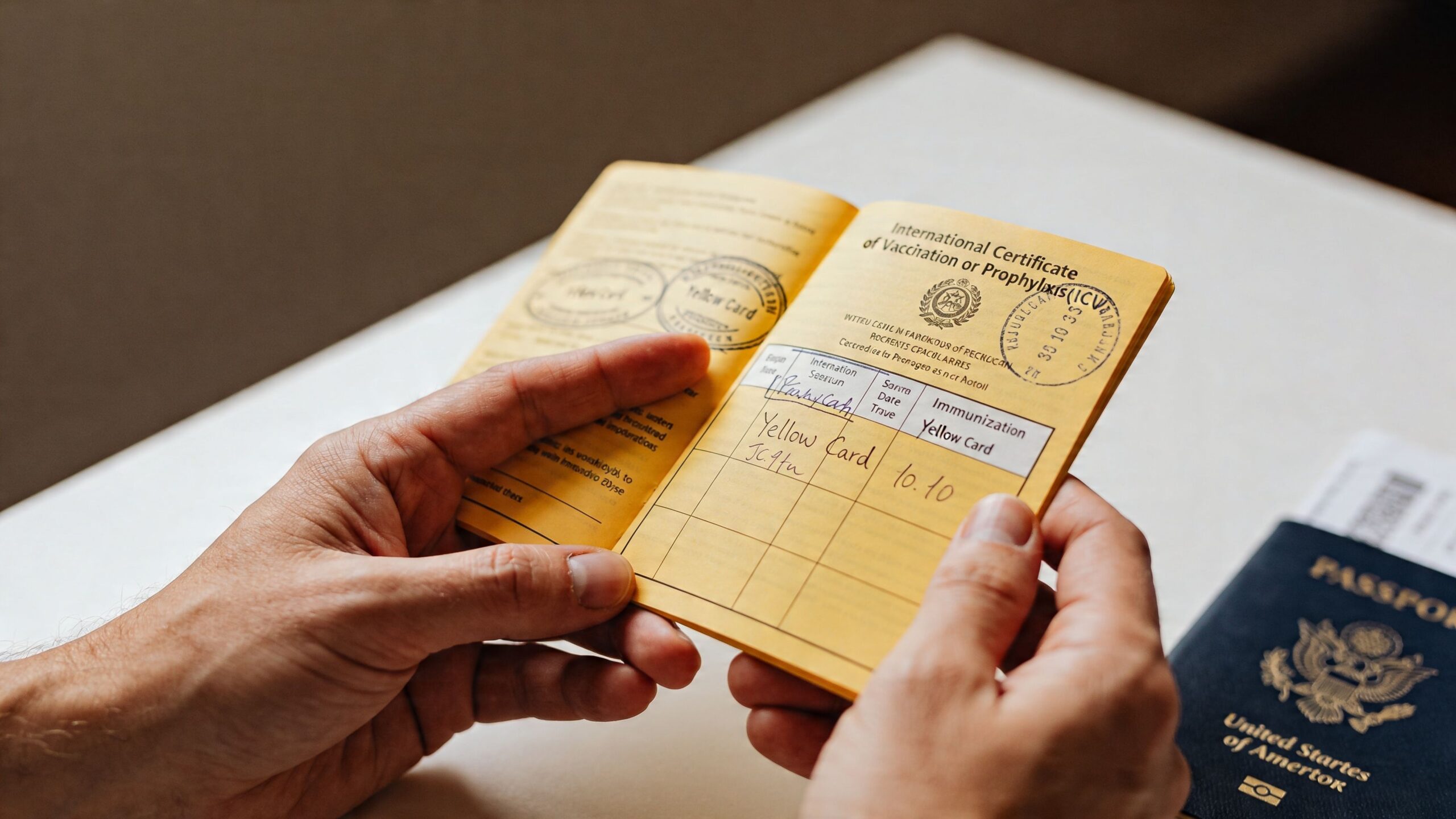
What the yellow card actually does
Think of the ICVP as a health passport for specific entry situations. It is not a general souvenir of vaccination. It is formal documentation that border officials may ask to see when a country applies yellow fever entry rules.
A valid card must be completed by an authorized vaccine provider. If the vaccine is documented incorrectly, signed improperly, or missing required details, the problem may not be discovered until you’re standing at the airport counter or immigration desk.
If you need a practical local overview of access and eligibility, this yellow fever vaccine resource explains what travelers should expect before booking.
How to protect your paperwork
Do three things once you receive the document:
Store it with your passport
Don’t place it in checked baggage.Take a clear photo
A digital copy won’t always replace the original, but it helps if details need to be verified.Review it before leaving the clinic
Check names, dates, and legibility immediately.
Border problems often come from paperwork errors, not from the vaccine itself.
If your itinerary includes a country with yellow fever entry rules, treat the document as essential travel gear.
Special Vaccine Considerations for Your Health
A common travel scenario looks simple at first. A patient books an international trip, checks the destination vaccine list, and assumes the next step is scheduling shots. Then the medical history changes the plan. Diabetes, kidney disease, heart disease, autoimmune conditions, cancer treatment, transplant medicines, biologic drugs, pregnancy, and older age can all affect which vaccines make sense, when to give them, and whether some should be avoided.
General travel advice is a starting point, not a final plan for travelers with chronic illness or a weakened immune system. These travelers often need closer review because infection risk, vaccine risk, and trip timing have to be weighed together.
Live vaccines deserve special attention. The National Foundation for Infectious Diseases notes that travelers with chronic conditions or immunocompromise may need modified schedules, and that live vaccines such as yellow fever may be unsafe for some people, with decisions sometimes involving inactivated options, antibody testing, or specialist review, as explained by the National Foundation for Infectious Diseases travel vaccine guidance.
Instead of only asking whether a vaccine is recommended for the country, a safer approach is to decide whether it fits your specific health profile and itinerary.
When your medical history changes the vaccine plan
I often slow the process down for patients who want to leave with every vaccine on the same day. That urgency is understandable, but good travel medicine is not just about giving more vaccines faster. It is about choosing the right vaccines, in the right order, with enough time to monitor side effects and account for your regular treatment plan.
A vaccine review may include:
Timing adjustments
Vaccines may need to be scheduled around infusion therapy, steroid use, surgery, dialysis, or periods when an autoimmune condition is flaring.Avoiding certain vaccines
Some immunocompromised travelers should not receive live vaccines because the risk can outweigh the benefit.Checking prior immunity
If records are incomplete or past vaccination is uncertain, antibody testing may help clarify protection.Adding non-vaccine protection
Food and water precautions, mosquito protection, altitude planning, medication packing, and hydration strategy can matter as much as the vaccines themselves.
The details matter.
A traveler with diabetes may need advice on sick-day management, insulin storage, time-zone changes, and how to respond quickly to vomiting or diarrhea. A traveler with hypertension or heart disease may need to review altitude exposure, long walking days, heat stress, and medication access during flight delays. A traveler taking immune-suppressing medication may need a more conservative plan because some vaccines are less effective and some are not appropriate at all.
For medically complex travelers, the safest plan is usually the one built early, with enough time to make careful choices before departure.
How Our Clinic Supports Your Travel Health Needs
Travel medicine works best when it’s organized around the patient, not around a generic destination handout. That means combining itinerary review, vaccine access, documentation, medication discussion, and chronic disease judgment in one place.

What travelers usually need in one visit
A well-run travel health appointment should help with more than injections. Most travelers need some combination of:
Itinerary review
Country-specific recommendations depend on where you’re going, how long you’ll stay, and what kind of travel you’re doing.Record review
Prior vaccines, missing records, and routine immunization gaps all need attention.Required vaccine planning
If yellow fever documentation may be necessary, the visit should address both the vaccine and the certificate process.Medical risk assessment
Chronic conditions, current medications, and immune status can change the plan.Clear next steps
You should leave knowing what was done, what still needs follow-up, and what documents to carry.
Why coordinated care matters
The travelers who benefit most from coordinated care are often the ones with the least room for error. Someone with uncomplicated health may only need a straightforward update. Someone with diabetes, hypertension, heart disease, or immune compromise may need vaccine decisions tied to their overall care plan.
That’s also why convenience matters. Same-day scheduling, urgent visits for last-minute travel, on-site vaccines, and access to follow-up questions all reduce missed steps. The process should feel organized, not fragmented.
Good travel care is not just “which shot do I need?” It is a short, focused medical review that turns uncertainty into a practical plan.
Frequently Asked Questions About Travel Immunizations
What should I bring to my travel vaccine appointment
Bring your itinerary, passport, any vaccine records you already have, and a current medication list. If you have chronic conditions, bring a brief summary of those conditions or your recent medication changes. If another doctor manages your immune-suppressing treatment or specialty care, bring that information too.
A written list beats memory. It saves time and reduces mistakes.
What if I have to travel last-minute
Still book the visit. Even when there isn’t much time, a clinician can often identify what is still worth doing, update routine vaccines, review documentation, and discuss protective steps that matter during the trip. Last-minute travel isn’t ideal, but it’s much better than flying without checking requirements at all.
What happens if I lose my Yellow Card
Start by contacting the clinic or authorized provider that issued it. If they documented the vaccination in their records, they may be able to help with replacement or re-documentation. Don’t wait until the day before departure to look for it. If your destination may inspect proof of yellow fever vaccination, missing paperwork can create real border trouble even if you already received the vaccine.
Keep the original with your passport and keep a photo backup on your phone.
If you need a clear plan for immunizations required for international travel, Maryland Primary and Urgent Care offers travel consultations, routine and destination-specific vaccines, and practical guidance for travelers with chronic conditions or more complex medical histories. Book early if you can, but if your trip is coming up fast, it’s still worth getting expert help before you go.