
If you’ve just been in a crash, you’re probably replaying the impact in your head, checking your car, and telling yourself you’re “probably okay.” That’s common. It’s also where people make mistakes that hurt both their recovery and their insurance claim.
The short answer to what to do after car accident injury is this: get safe, get examined, and start documenting immediately. Even low-speed collisions can cause injuries that don’t fully show up until the adrenaline wears off. The World Health Organization notes that road traffic crashes cause about 1.19 million deaths worldwide each year and leave 20 to 50 million people with non-fatal injuries, with delayed care increasing injury severity and long-term disability risk, according to the WHO road traffic injury fact sheet.
Table of Contents
- Your First 24 Hours After a Car Accident Injury
- Securing Your Safety and Evidence at the Scene
- Deciding Between the ER and Urgent Care
- How to Document Injuries and Evidence for Insurance
- Navigating Follow-Up Care and Delayed Symptoms
- Frequently Asked Questions After a Car Accident
- Should I see a doctor if I felt fine at the scene?
- What if the other driver’s insurance company calls me quickly?
- How do I track delayed symptoms without making the process complicated?
- I’m not a U.S. citizen. Does my medical documentation matter beyond insurance?
- When can I return to work or exercise?
- What if I don’t have severe pain, just stiffness and headaches?
Your First 24 Hours After a Car Accident Injury
In the first few hours, people usually focus on the car. The body gets less attention. That’s backwards.
Your priorities are simpler than most checklists make them sound. They fall into three areas: safety, medical evaluation, and documentation. If you handle those well in the first day, you avoid most of the problems I see later in urgent care.
First, make sure everyone is out of immediate danger. If the vehicle can be moved safely, get out of traffic. If you think anyone may be injured, call emergency services right away.
Second, get medically evaluated even if you think you “just feel sore.” After a crash, adrenaline often masks pain. Headaches, neck stiffness, dizziness, back pain, chest wall pain, and numbness may show up later. That’s one reason it helps to understand why seeing a doctor after a car accident matters.
Practical rule: If you were hit hard enough to exchange insurance information, you were hit hard enough to assess your body carefully.
Third, begin documenting while details are fresh. Write down the time, location, direction of travel, what you remember, and what symptoms started that day. Keep it factual. Don’t guess. Don’t try to sound legal. Just record what happened and what you feel.
If you’re outside Maryland, local legal and insurance steps can differ, so state-specific resources can help. Drivers looking for advice for PA and NJ drivers may find that breakdown useful for reporting and claim handling.
Securing Your Safety and Evidence at the Scene
The crash scene is where many preventable claim problems start. People either leave too quickly, say too much, or collect the wrong evidence.

What to do before you leave
Use this order:
- Protect the scene. Turn on hazard lights. If the car is drivable and you can move it safely, get it out of active traffic.
- Call 911. An official police report matters. The National Safety Council notes that immediate reporting is critical for insurance processing, and U.S. motor vehicle crashes created over $457 billion in economic costs in 2023 in the NSC motor vehicle overview.
- Check people before property. Look for bleeding, confusion, trouble walking, chest pain, or breathing problems.
- Exchange the basics. Get names, phone numbers, insurance details, license numbers, registration information, and plate numbers.
- Avoid fault language. Don’t argue, accuse, apologize, or speculate.
A useful script for the 911 call is simple: location, number of vehicles, whether traffic is blocked, and whether anyone may be injured. That’s enough to get the right response started.
What evidence matters most
Not all photos help equally. The most useful evidence is the kind that tells the whole story, not just that two cars touched.
- Wide scene photos that show lane position, intersection layout, road markings, and traffic signs
- Vehicle photos from several angles, including close shots of damage and license plates
- Road condition photos showing debris, standing water, skid marks, or visibility issues
- Witness details with names and phone numbers if anyone saw the crash
Don’t use the scene to explain your case. Use it to preserve facts.
What doesn’t work is taking three close-up photos of a bumper and nothing else. Insurers and clinicians both need context. The location of impact, the angle, and the visible force of collision help explain what injuries are plausible.
Deciding Between the ER and Urgent Care
Choosing where to go next is a medical decision, not just a convenience decision. Some injuries belong in an emergency room immediately. Others are better handled in urgent care, where the visit is often faster, calmer, and easier to follow up.
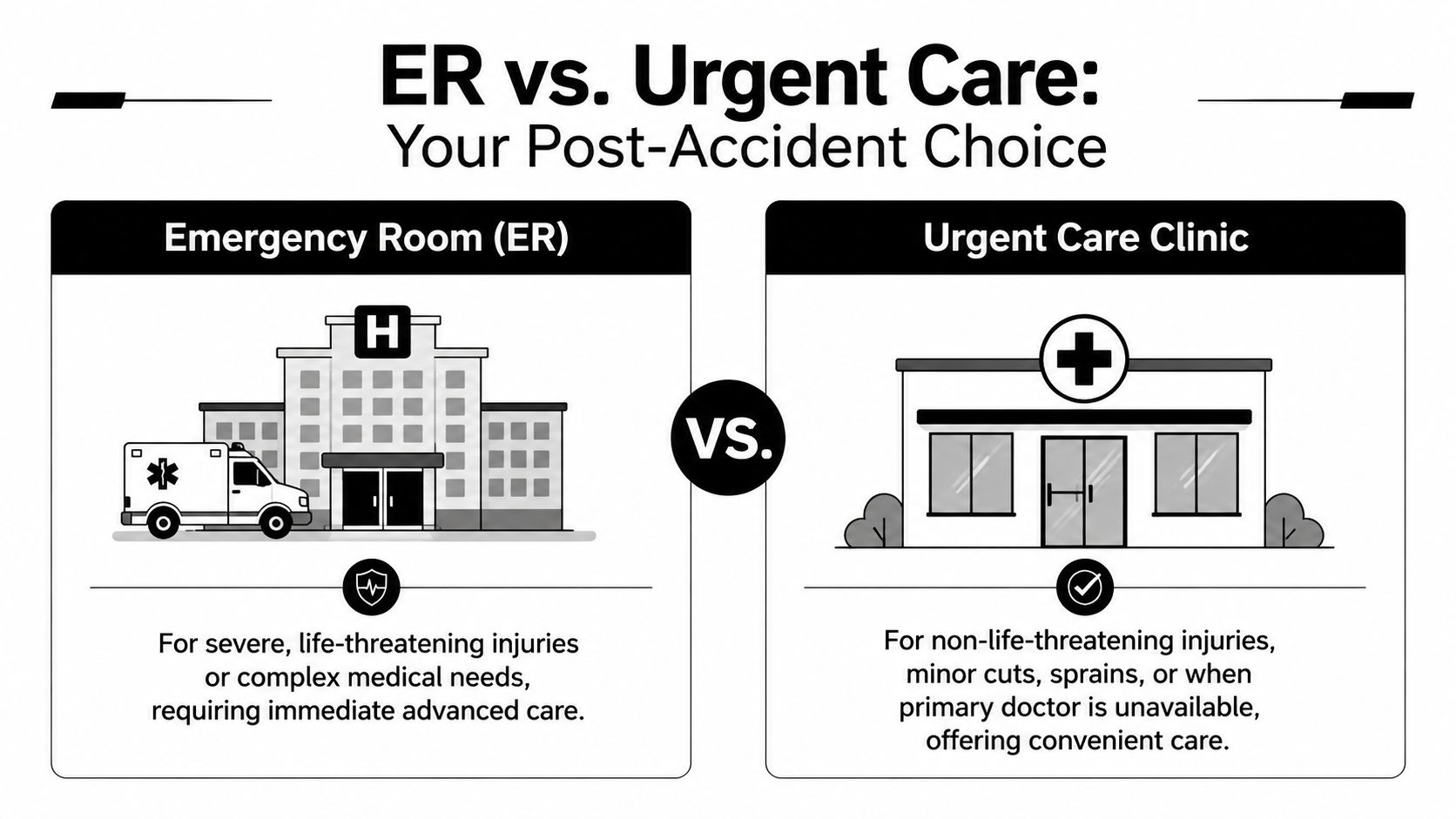
If you’re trying to decide, this side-by-side guide helps. It also complements this overview of urgent care versus the ER.
Go to the ER now if you have
- Loss of consciousness or even a brief blackout
- Severe bleeding or wounds that may need advanced repair
- Shortness of breath or significant chest pain
- Severe abdominal pain
- Obvious deformity suggesting a fracture or dislocation
- Sudden weakness, confusion, or repeated vomiting
- Worsening severe headache after head impact
Those symptoms raise concern for injuries that may need imaging, monitoring, or hospital-based treatment without delay.
Urgent care is often appropriate for
- Neck pain or stiffness
- Back strain
- Headache without red-flag neurologic symptoms
- Minor cuts or abrasions
- Bruising
- Shoulder, wrist, or knee pain when the injury seems stable
- Delayed soreness that starts after you get home
For many patients, this is the more practical setting. The visit is usually more focused on the injury itself and less chaotic than a crowded emergency department.
ER vs. Urgent Care for Auto Accident Injuries
| Symptom/Condition | Recommended Location | Reasoning |
|---|---|---|
| Loss of consciousness | ER | Possible brain injury needs immediate advanced evaluation |
| Heavy bleeding | ER | May require urgent intervention and monitoring |
| Chest pain after steering wheel or seat belt impact | ER | Could involve internal injury and needs rapid assessment |
| Severe abdominal pain | ER | Internal injury must be ruled out quickly |
| Neck stiffness without neurologic symptoms | Urgent Care | Common after crashes and often appropriate for prompt outpatient evaluation |
| Back soreness that appears later | Urgent Care | Needs exam and documentation, but usually not hospital-level care |
| Minor cuts and bruises | Urgent Care | Can be assessed and treated efficiently |
| Persistent but mild headache | Urgent Care | Important to evaluate and document if stable |
If your symptoms are severe, escalating, or frightening, skip the debate and go to the ER.
For non-life-threatening injuries, a dedicated auto accident clinic can make the next few weeks easier because treatment, rechecks, and documentation stay in one place. One local option is Maryland Primary and Urgent Care, which offers walk-in and scheduled care for auto accident injuries along with follow-up coordination.
How to Document Injuries and Evidence for Insurance
Good documentation isn’t paperwork for paperwork’s sake. It is how you show what happened, when symptoms started, and how your condition changed over time.

Detailed scene evidence has real value. Expert guidance on documentation emphasizes capturing vehicle damage, license plates, road conditions, traffic signs, and witness information, because that evidence gives clinicians mechanism-of-injury context and can support faster claims handling, as described in this auto accident evidence guide.
Start with the scene and visible injuries
Take photos that answer basic questions. Where did the crash happen? How were the cars positioned? What part of the vehicle took the hit? What did your body look like in the hours after the crash?
Your photo set should include:
- The overall location with street signs or landmarks
- Each vehicle from front, rear, and side angles
- Close-ups of damage
- Road details such as lane markings, signals, debris, and weather-related conditions
- Visible injuries like bruising, abrasions, swelling, or seat belt marks
Then save everything in one folder. Don’t scatter photos across texts, social media, and random screenshots.
Build a medical record that makes sense
A claim gets weaker when the medical record is fragmented. One visit to the ER, then silence for two weeks, then a late urgent care visit creates openings for the insurer to question the timeline.
Keep a simple injury journal. It can be a notes app, a paper notebook, or a document on your phone. Record:
- What hurts
- When symptoms appear
- What makes them worse
- What activities you can’t do normally
- Any missed work or interrupted sleep
One state-specific example shows why timing matters. In Florida, seeking treatment within 14 days can determine eligibility for PIP benefits, according to this post-crash checklist discussing the 14-day rule. Even if that exact rule doesn’t apply where you live, the lesson does. Early, time-stamped evaluation protects the record.
A quick visual explanation can help if you’re organizing a claim for the first time:
Navigating Follow-Up Care and Delayed Symptoms
The crash visit is only the beginning. Some of the most important findings show up later, especially with neck injuries, soft tissue injuries, and head trauma.

Delayed symptoms are common enough that patients should expect them, not dismiss them. Traumatic brain injury symptoms can appear days or weeks after a crash, and there are over 2.8 million TBI-related ER visits annually in the U.S., with many tied to auto accidents, while claims are often disputed when follow-up records are inconsistent, as noted in this discussion of post-accident TBI follow-up.
Symptoms that deserve attention even if they start later
Come back for reassessment if you notice any of these after the first visit:
- Headaches that persist or intensify
- Dizziness or balance problems
- New light sensitivity
- Brain fog, poor concentration, or memory trouble
- Neck pain that spreads into the shoulders or arms
- Numbness or tingling
- Sleep disruption after head or neck injury
- Chest discomfort after seat belt or steering wheel impact
A symptom that starts on day three is still part of the accident story if the record shows the timeline clearly.
Patients get into trouble with the “wait and see” approach. Waiting can be reasonable for a minor bruise. It is not a good strategy for concussion symptoms, worsening neck pain, or numbness.
Why coordinated care works better than scattered visits
A one-off ER visit is useful when you need emergency stabilization. It’s not designed to manage the next several weeks. Recovery after a crash is often iterative. Symptoms evolve. Range of motion changes. Work restrictions may need updating. Physical therapy or specialty referral may become appropriate.
That’s why continuous care matters. One clinic tracking the injury from the first evaluation through rechecks usually creates a cleaner medical record than separate visits at unrelated locations.
Patients also often need rehabilitation input after the acute phase. If you’re considering therapy for stiffness, limited motion, or functional recovery, this guidance for car accident recovery gives a practical view of where physical therapy fits. If you need ongoing local follow-up, finding a car accident injury clinic near you can make it easier to keep care and documentation consistent.
Frequently Asked Questions After a Car Accident
Should I see a doctor if I felt fine at the scene?
Yes. Feeling “fine” right after impact doesn’t rule out injury. Adrenaline can blunt pain, and symptoms like whiplash, concussion, or back spasm may show up later. Early evaluation also creates a medical record close to the event.
What if the other driver’s insurance company calls me quickly?
You can report facts, but keep it limited and accurate. Don’t guess about speed, force, or fault. Don’t downplay symptoms just because you’re still sorting them out. If your symptoms change, your medical follow-up should reflect that.
How do I track delayed symptoms without making the process complicated?
Keep a daily log. Note headaches, dizziness, neck stiffness, sleep disruption, numbness, trouble concentrating, and activities you can’t do normally. Short, factual entries work better than long emotional summaries.
I’m not a U.S. citizen. Does my medical documentation matter beyond insurance?
Yes. For immigrants and non-citizens, continuity of care can matter in other processes as well. Documentation through primary care or urgent care may be important for USCIS-related medical issues, and a 2025 Department of Justice report found 15% of accident claims for non-citizens were denied due to poor medical continuity, according to this overview of immediate post-accident priorities. If you’re dealing with immigration paperwork, keep every visit summary, prescription, imaging result, and work note.
When can I return to work or exercise?
Return depends on the injury, not the calendar. A person with mild soreness may resume normal activity quickly. Someone with concussion symptoms, significant neck strain, or restricted motion may need temporary limits. If an activity increases pain, dizziness, or neurologic symptoms, get re-evaluated before pushing through it.
What if I don’t have severe pain, just stiffness and headaches?
That still deserves medical attention. Many crash-related injuries begin exactly that way. The key question isn’t whether the pain is dramatic. It’s whether the symptom started after the collision and needs proper assessment and documentation.
If you need prompt evaluation after a crash, Maryland Primary and Urgent Care offers walk-in and scheduled care for auto accident injuries, along with follow-up that helps patients track delayed symptoms, document recovery clearly, and get coordinated treatment without unnecessary gaps.