
A pre employment drug test and physical is a routine screening that usually combines a drug screen with a basic medical exam to confirm you can safely perform the job. In most workplaces that test, the most common drug screen is the 5-panel urine test, and urine testing can generally detect drug metabolites within a 5 to 10 day window after use.
If you’ve just accepted a conditional job offer in Lanham or elsewhere in Prince George’s County, this step can feel bigger than it is. Most applicants aren’t worried about the exam itself. They’re worried about the unknowns. What will the clinic ask? What if you take prescription medication? What if the physical turns up high blood pressure or another chronic condition you’re already managing?
Those are reasonable concerns. The good news is that this process is usually straightforward when you know what to expect and show up prepared.
Table of Contents
- Your Job Offer and the Next Step
- Decoding the Pre-Employment Drug Test
- What the Pre-Employment Physical Exam Covers
- How to Prepare for Your Appointment
- Your Local Solution in Lanham Maryland
- Frequently Asked Questions About Pre-Employment Screening
Your Job Offer and the Next Step
A conditional job offer often comes with one last requirement. You need to complete a pre employment drug test and physical before your start date. That doesn’t mean the employer expects a problem. It means the employer wants a consistent hiring process.
In plain terms, the drug test looks for recent substance use based on the employer’s policy. The physical checks whether you can perform the role safely and whether any medical issue needs follow-up before clearance. For many applicants, it’s less dramatic than it sounds.
Employers use these screenings for practical reasons. They want to reduce safety risks, document job readiness, and make sure the hiring process follows workplace rules from the start. The widespread use of pre-employment urine drug screening reflects that it remains a standard part of workplace safety programs, especially because the 5-panel urine test is cost-effective, accurate, and commonly used by employers in the United States, as outlined in this overview of the most common pre-employment drug test.
What usually happens after you arrive
Most visits follow a simple sequence:
- Check-in and paperwork. You’ll present identification and employer forms, then complete medical history questions.
- Drug screen collection. If your employer ordered a urine drug test, staff will explain the collection process.
- Physical exam. A clinician reviews your history, checks vital signs, and performs the job-related exam.
- Next-step instructions. If everything is routine, your paperwork moves forward. If something needs clarification, the clinic explains what documentation or follow-up is required.
Practical rule: A pre-employment exam is not the same as a full annual physical. It’s focused on whether you can safely do the job you were hired for.
Why applicants feel anxious
Most anxiety comes from uncertainty, not from the exam itself. Applicants often worry about three things:
- Medication questions. Prescription and over-the-counter drugs can matter, so bring an accurate list.
- Chronic conditions. Conditions like hypertension or diabetes don’t automatically disqualify you, but they may need review.
- Timing. Delays usually happen because forms are missing or the applicant didn’t bring the right information.
If you go in informed, honest, and organized, the process is usually smooth.
Decoding the Pre-Employment Drug Test
Drug screening is the part most applicants focus on first, and usually for the wrong reason. People often assume it is looking for impairment at that exact moment. In reality, the test usually looks for metabolites, which are the chemical footprints a substance leaves behind after your body processes it.
That distinction matters. A drug screen is not a conversation about character. It is a laboratory process tied to an employer’s policy.
Why employers use drug screening
Employers usually order drug testing to support workplace safety, hiring consistency, and risk management. That approach is still common even though laws and workplace policies have changed around some substances.
One useful reality check is that testing is not as universal as many people think. According to Quest Diagnostics, the share of jobs requiring pre-employment drug testing is lower than 2%, and the sectors most likely to require it are government roles, followed by healthcare and hospitals, then manufacturing, as described in Quest’s Drug Testing Index analysis.
Screening isn’t a sign that your employer distrusts you. It’s usually a sign that they use the same hiring standard for every candidate in that role.
What the 5-panel urine test checks for
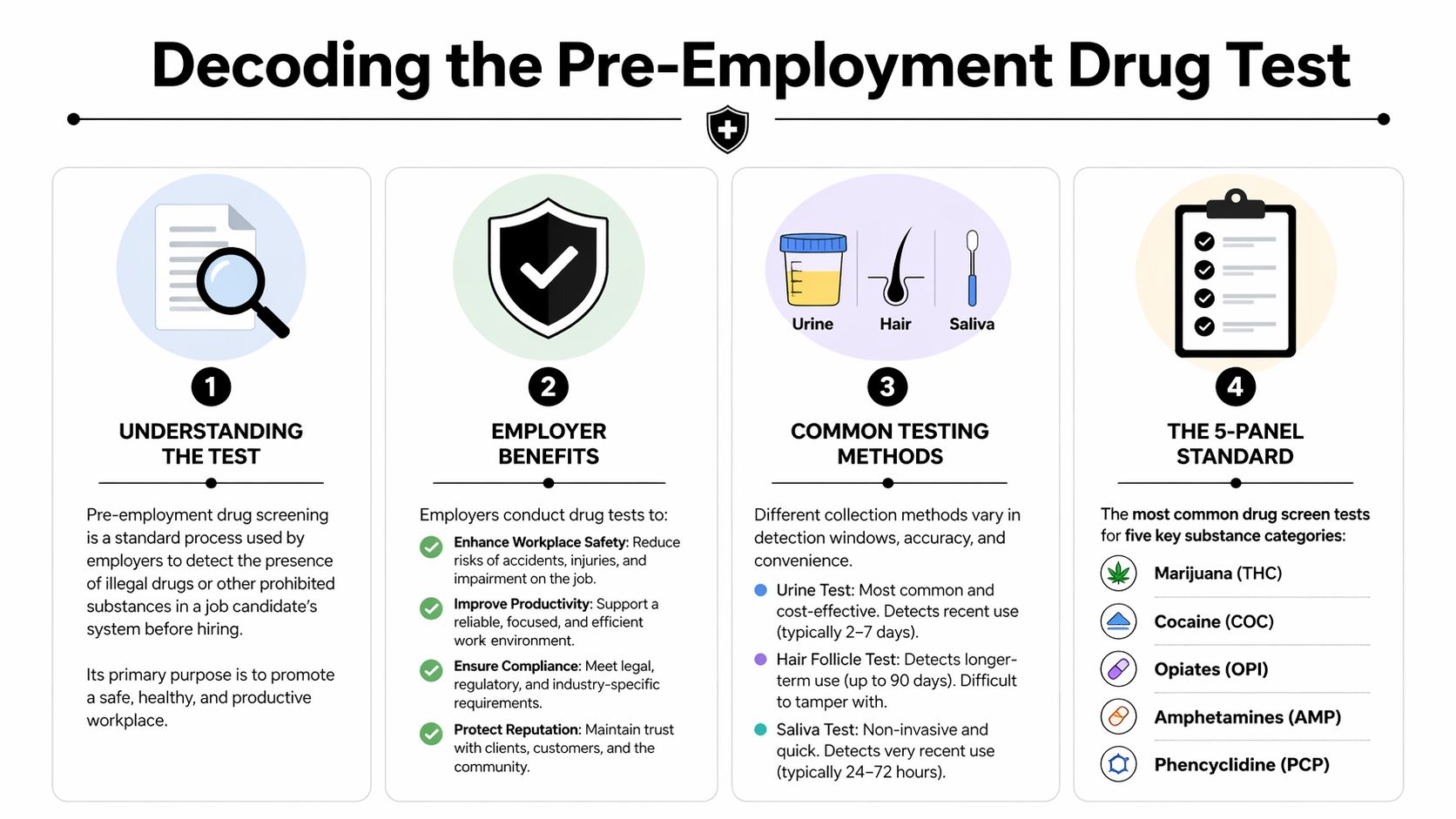
The 5-panel urine test is the most common pre-employment drug test used by employers. It screens for THC, cocaine, opioids, amphetamines, and PCP.
Why urine? Because it’s widely used, practical for recent drug-use assessment, and familiar to employers and clinics. If your employer sent you for a urine tox screen, that is standard, not unusual. Clinics that handle occupational screening often coordinate this alongside other lab services for employer testing and urine screening.
A frequent point of confusion is the idea of a 10-panel test. Some employers may choose broader testing panels, but whether that applies depends on the employer’s written program. If your paperwork only specifies a standard urine drug screen, don’t assume you are getting a larger panel.
How different test types compare
Different specimen types answer different questions. The choice depends on how the employer balances recency, convenience, and cost.
| Test type | Typical detection window | Main use |
|---|---|---|
| Urine | 5 to 10 days | Common choice for recent drug use screening |
| Saliva | 12 to 48 hours | Shorter lookback, non-invasive collection |
| Hair | Months | Longer retrospective view of use patterns |
Those windows come from this guide on pre-employment drug testing methods.
Here’s the trade-off in plain language:
- Urine testing works well when an employer wants a practical screen for recent use.
- Saliva testing is useful when the employer wants a much shorter lookback period.
- Hair testing is more about longer-term patterns than very recent use.
If you’re taking legitimate prescription medication, disclose it exactly as instructed by the clinic. That’s better than trying to explain it later after a result is flagged for review.
What the Pre-Employment Physical Exam Covers
The physical exam is separate from the drug screen, even when both happen in the same visit. It is not a pass-fail event based on looking perfectly healthy. It is a job-related medical review.
Most non-DOT pre-employment physicals focus on whether you can perform the role’s essential tasks safely. For one job, that may mean confirming stable vision and normal movement. For another, it may mean reviewing whether a chronic condition is controlled well enough for regular work duties.
What happens during the exam
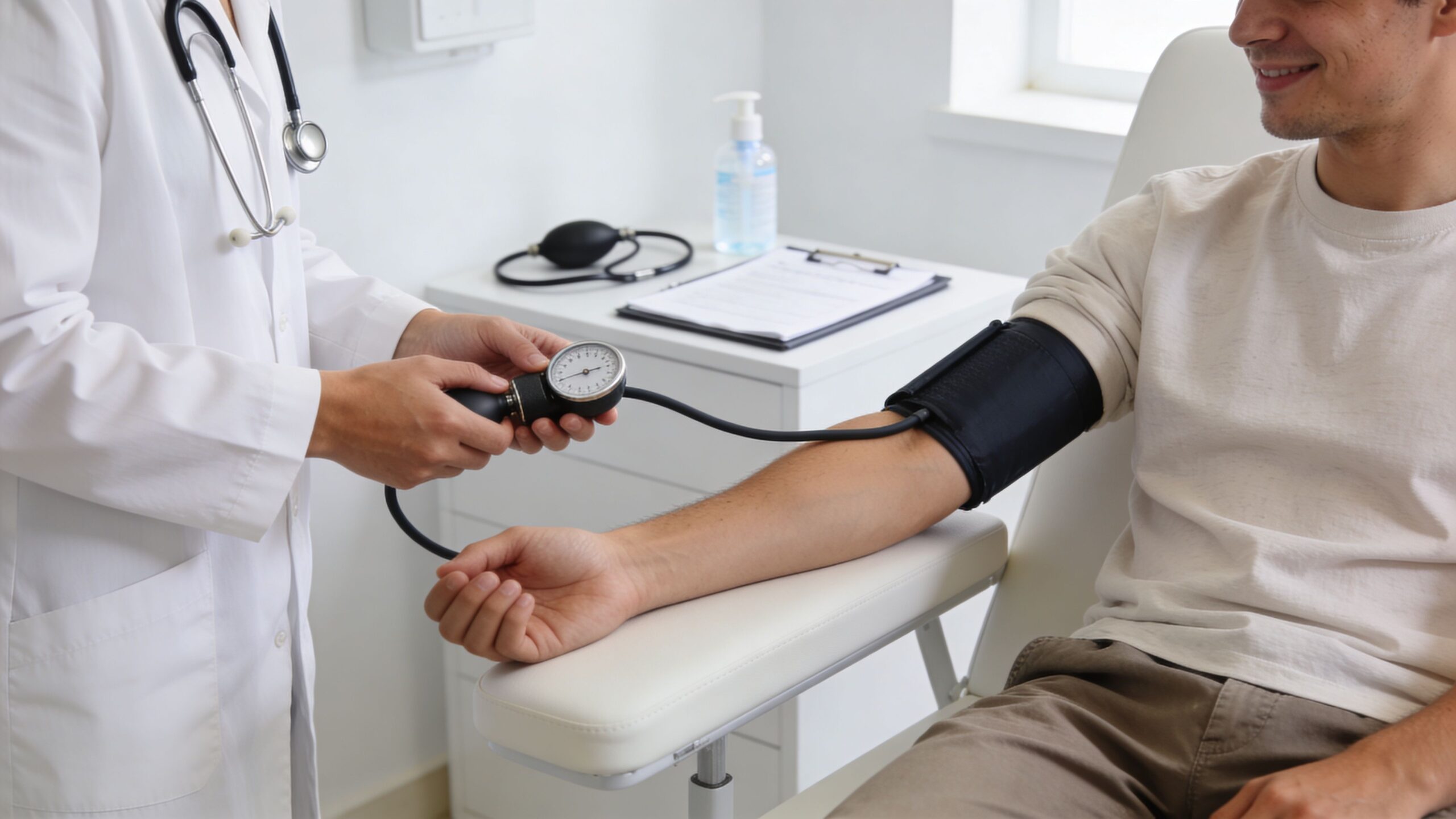
A standard visit usually includes a medical history review and a basic exam. The clinician is looking for information that is relevant to the job, not trying to create a long list of unrelated findings.
Typical parts of the exam include:
- Medical history review. Expect questions about prior surgeries, ongoing treatment, allergies, and current medications.
- Vital signs. Blood pressure, pulse, temperature, and sometimes weight are commonly recorded.
- Vision and hearing checks. Some jobs require this, especially if the role depends on clear communication or safe operation of equipment.
- General physical assessment. The clinician may listen to your heart and lungs and review basic musculoskeletal function such as range of motion or balance.
If your employer ordered a work physical, it helps to know what that clinic usually includes in its pre-employment and occupational physicals.
Bring your medication list exactly as you take it. Names alone are helpful. Names with dose and timing are better.
What happens if a chronic condition is found
This is the part many applicants worry about most. A chronic condition does not automatically mean you fail the physical.
Candidates with chronic conditions discovered during pre-employment physicals may need additional evaluation to determine medical clearance. The review asks whether the condition, with reasonable accommodation if needed, would prevent the person from performing the essential job functions or conflict with compliance requirements such as OSHA or ADA guidance, as explained in this pre-employment physical exam guide.
A practical way to think about it is this:
| Situation | What often happens next |
|---|---|
| Condition is known and well managed | The clinician may document it and move forward |
| Condition needs clarification | You may be asked for records, medication details, or a note from your treating doctor |
| Condition may affect job tasks | The employer may review whether accommodation is appropriate |
This review is about function, not labels. A diagnosis by itself doesn’t answer the only question that matters in a pre-employment setting, which is whether you can do the essential duties safely.
If the clinic finds high blood pressure, poorly controlled diabetes, or another issue that needs more information, don’t panic. The next step is often documentation, follow-up, or medical clearance, not an automatic rejection.
How to Prepare for Your Appointment
Good preparation prevents most delays. Applicants who have trouble during a pre employment drug test and physical usually don’t have a medical problem. They’re missing paperwork, forgot their ID, or show up without the information the clinician needs.

What to bring
Start with the basics. Put everything in one folder the night before.
- Photo identification. Bring a government-issued ID unless your employer gave different instructions.
- Employer paperwork. This may include the authorization form, job description, or screening request.
- Medication list. Include prescriptions, over-the-counter products, and supplements.
- Glasses, contacts, or hearing aids. If you use them regularly, bring them.
- Relevant records. If you already know a condition may come up, bring recent notes or clearance documents if you have them.
Industry can also give you a clue about whether screening is likely. Government roles are the most common jobs to require pre-employment drug testing nationally, followed by healthcare and hospitals, then manufacturing, according to the earlier-linked Quest analysis.
What to do the day of the exam
Don’t overcomplicate it. Routine habits work better than trying to “game” the visit.
- Drink normal fluids. You want to be able to provide a urine sample, but overhydrating can create problems.
- Take prescribed medication as directed. Skipping medication to change your numbers can backfire and create a less accurate exam.
- Eat normally unless told otherwise. Most pre-employment screenings don’t require fasting.
- Wear practical clothing. Choose clothes that allow easy movement if the exam includes range-of-motion testing.
- Arrive a little early. Rushing raises stress and increases the chance you’ll fill out forms inaccurately.
The smoothest appointments usually come from simple preparation, not special tricks.
If you use cannabis or take controlled medication by prescription, read your employer’s instructions carefully and answer clinic questions accurately. Accuracy helps more than improvisation.
Your Local Solution in Lanham Maryland
For applicants in Lanham, the easiest setup is usually a clinic that can handle both parts of the process in one place. That reduces handoffs, repeated paperwork, and confusion about where results are supposed to go.
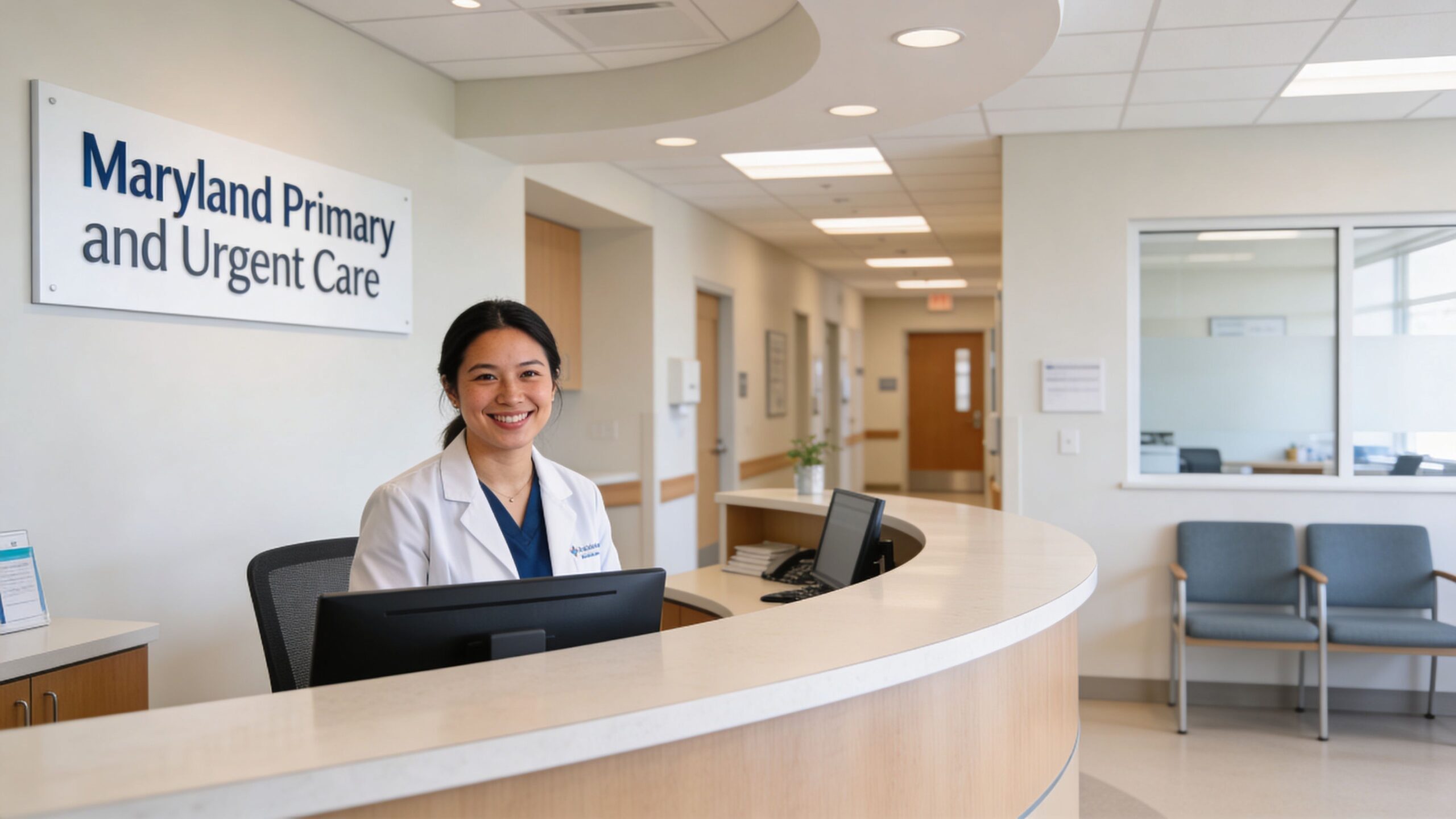
A practical local option is Maryland Primary and Urgent Care in Lanham, which provides adult primary care, urgent care, physicals, and on-site lab support. For a job applicant, that matters because a combined visit is usually easier to schedule than trying to coordinate separate locations for the drug screen and the physical.
Why one-visit screening helps
From the applicant’s side, convenience isn’t just about saving time. It also lowers the chance of administrative problems.
A one-visit approach can help with:
- Fewer scheduling gaps. You’re less likely to miss an employer deadline.
- Cleaner paperwork flow. The clinic can collect forms once and match them to the right exam.
- Less back-and-forth. If the clinician needs clarification, it’s easier to address it during the same visit.
- Better continuity. If the physical raises a follow-up issue, the same clinic can often explain what records are needed.
What local applicants should look for in a clinic
Not every urgent care is set up the same way for employment screening. Before you book, ask direct questions.
| What to ask | Why it matters |
|---|---|
| Can you do both the physical and drug screen in one visit? | This reduces delays and duplicate intake forms |
| Do you accept walk-ins or same-day appointments? | Helpful when employers give short deadlines |
| Do you have on-site lab capabilities? | Simplifies specimen handling and coordination |
| What documents should I bring? | Prevents rescheduling because of missing forms |
A local clinic should also be clear about follow-up. If your screening shows a medical issue that needs more review, you want a practice that explains the next step in plain language instead of sending you away with vague instructions.
Frequently Asked Questions About Pre-Employment Screening
A lot of applicants in Lanham ask the same question after they get the employer form. “What happens if something comes up?” That concern is reasonable. In urgent care, I see applicants who are less worried about the urine cup or blood pressure cuff than they are about whether one finding will derail the job offer.
Who pays for the pre-employment screening
Usually, the employer pays because the screening is part of its hiring process. Some employers ask applicants to schedule the visit themselves, and a smaller group may ask the applicant to pay up front and request reimbursement later.
Do not guess. Ask before you arrive so there is no confusion at check-in.
What happens if I test positive on the drug test
The next step depends on the employer’s policy and the review process tied to that test. A result that is not reported as negative does not automatically mean the clinic makes the hiring decision. The employer does.
If you take a prescription medication, follow the instructions given for disclosure and verification. That step matters. In many cases, the result goes through a formal review process before the employer receives the final report.
What if I don’t pass the physical
An incomplete or delayed clearance can happen for a few different reasons. Sometimes the issue is minor, such as missing vaccine records, unreadable paperwork, or a blood pressure reading that needs to be rechecked. In other cases, the clinician may need records from your primary care doctor or a specialist before signing off.
That does not always end the process.
In practice, the question is whether you can safely perform the job duties listed by the employer. If more information is needed, a good clinic explains exactly what is missing and what to do next.
Is my medical information private
Yes. Your medical information is generally treated as private health information, and employers usually receive the work status or fitness determination they requested, not open access to your full chart.
If you want broader context on how hiring checks are typically organized, this guide to the pre-employment screening process gives a useful overview.
Can I refuse the drug test or physical
You can refuse. The employer can also decide not to continue the hiring process if the screening is a condition of employment.
If you are unsure why a test was ordered, ask before the appointment. That is much better than missing a deadline or walking out mid-visit.
Can a chronic condition automatically disqualify me
No. A diagnosis by itself usually does not decide the outcome. What matters is how the condition affects the specific job duties and whether the employer can make a reasonable accommodation.
This is the part many applicants worry about, especially if they have asthma, diabetes, high blood pressure, an old back injury, or another long-term condition. In clinic, we do not treat every chronic diagnosis as a stop sign. We look at current control, medication use, symptoms, safety concerns, and whether more documentation is needed. Sometimes the applicant is cleared the same day. Sometimes we ask for a note from the treating physician or recommend follow-up before final clearance.
For applicants in Lanham, that local follow-up matters. If you need a pre employment drug test and physical in Lanham, Maryland Primary and Urgent Care offers one location for screening, paperwork review, and clear instructions on what to do if a chronic condition needs a second look.