
If you’re preparing your green card paperwork and staring at the medical exam requirement with a mix of confusion and worry, that’s normal. Most first-time applicants don’t need a lecture. They need a clear explanation of what the immigration medical exam requirements are, who must do it, what to bring, and what can delay the form.
The short answer is this: for most green card applicants, the USCIS medical exam is a required screening completed on Form I-693 by a USCIS-designated civil surgeon. It’s used to check for certain health-related grounds of inadmissibility, confirm required vaccinations, and document whether additional treatment or follow-up is needed before the form can be signed and sealed.
Table of Contents
- Who Needs a USCIS Medical Exam and Why
- Finding a Designated USCIS Civil Surgeon
- The Medical Exam Explained Step-by-Step
- Navigating USCIS Vaccination Requirements
- Costs, Timelines, and Managing Your I-693 Form
- Special Considerations and Waivers
- Frequently Asked Questions
Who Needs a USCIS Medical Exam and Why
You are ready to file for a green card, your forms are almost done, and then one question stops everything: Do I need the immigration medical exam, and what is USCIS checking?
For many applicants adjusting status inside the United States, the answer is yes. The exam is part of how USCIS reviews health-related grounds of inadmissibility under the Immigration and Nationality Act and confirms vaccination compliance through Form I-693. It is not a routine physical. It is legal-medical documentation prepared for an immigration case.
Individuals filing Form I-485 for permanent residence in the United States typically need this exam. Applicants processing an immigrant visa abroad usually complete a similar medical exam with a panel physician instead of a USCIS civil surgeon. If you are still unsure which doctor type applies to your case, this guide to finding a USCIS civil surgeon near you explains the distinction clearly.
Why USCIS requires it
USCIS is not asking whether you are in perfect health. The agency is checking a narrower set of issues that matter for admissibility.
The exam is used to document whether the applicant has certain communicable diseases of public health significance, whether required vaccines are complete or properly waived, and whether there is a physical or mental disorder associated with harmful behavior that must be evaluated under the immigration rules. That limited scope is why the visit often feels more procedural than a regular primary care appointment.
That distinction matters in practice. A person can be generally healthy and still need follow-up paperwork because a vaccine record is incomplete. Another applicant may have a past positive TB test and no current symptoms, but still need prior chest X-ray reports or treatment records to avoid delays. I see that misunderstanding often. The problem is usually documentation, not the applicant’s overall health.
Who should expect to need one
Most adjustment of status applicants should plan for an exam unless USCIS instructions for their category say otherwise.
That includes many applicants applying through family, employment, asylum-based adjustment, and other paths to permanent residence. Asylum seekers often assume the medical exam was already handled during earlier screenings. Usually it was not completed in the Form I-693 format required for adjustment of status, so a separate immigration medical exam is still needed at the green card stage.
Some applicants also worry that a sensitive medical history will create a problem by itself. In many cases, it does not. A past TB diagnosis, prior treatment, pregnancy, trauma history, or being an FGM survivor does not automatically prevent approval. What matters is accurate classification, proper records, and a civil surgeon who handles the exam carefully and documents findings the way USCIS expects.
Common points of confusion
Several parts of this requirement catch first-time applicants off guard:
- The exam is case-specific. Your regular annual checkup does not replace Form I-693.
- Records matter. Old vaccine cards, school records, translated immunization booklets, and prior TB treatment documents can change what you need at the visit.
- Past TB history needs extra attention. A prior positive skin test or blood test does not mean you have active TB, but it often changes what follow-up documentation the civil surgeon needs.
- Special situations deserve planning. Applicants with trauma histories, asylum cases, or FGM-related concerns may need a more careful, more private exam process.
One recent procedural point matters too. USCIS now expects applicants to pay close attention to when Form I-693 is submitted with Form I-485. Filing strategy affects whether a case moves cleanly or gets delayed, so applicants should verify the current filing instructions before sending the package.
Treat the medical exam as part of the immigration filing, not as a side appointment. That approach prevents many of the delays I see.
Finding a Designated USCIS Civil Surgeon
The first practical step is choosing the right doctor. Not a family physician. Not an urgent care that “does physicals.” Not a clinic that says it can help with immigration paperwork unless it specifically has a USCIS-designated civil surgeon.

How to search the right way
Use the official USCIS civil surgeon search tool first. Then call the clinic directly.
When you call, don’t ask only, “Do you do immigration exams?” Ask better questions:
- Is the doctor currently listed as a USCIS civil surgeon?
- Do you complete Form I-693 on site?
- Can you review vaccine records from another country?
- Do you offer blood work, urine testing, and TB testing through the same office or coordinated on-site services?
- If I had a prior positive TB test or prior treatment, what records should I bring?
- How is the sealed form returned to me?
Those questions tell you very quickly whether the clinic handles these exams routinely or only occasionally.
What makes a clinic easier to work with
A good civil surgeon office doesn’t just schedule the exam. It should be able to manage the logistics that cause delays.
Look for these features:
| What to check | Why it matters |
|---|---|
| On-site or coordinated labs | Fewer outside referrals means fewer chances for delay |
| Vaccine availability | Missing vaccines can often be handled without another trip |
| Staff familiar with foreign records | Translation and vaccine interpretation are common issues |
| Clear instructions for prior TB or STI treatment records | Missing documentation often slows sign-off |
| A process for sealed I-693 handling | This reduces preventable filing mistakes |
One local example is Dr. Sherif Hassan at Maryland Primary and Urgent Care in Lanham, Maryland, which offers immigration medical exams through a designated civil surgeon as part of its USCIS-related services. If you want a location-specific overview of the process, this guide on finding a civil surgeon near you is a useful starting point.
Don’t choose a clinic based only on the cheapest quoted fee. If the office can’t handle vaccines, labs, or prior-record review smoothly, the lower price can cost you more time and more repeat visits.
What to bring to the first appointment
Before the visit, gather the records that matter most:
- Government ID: Passport or other accepted photo identification
- Vaccination records: Originals if possible
- Prior treatment records: Especially for TB, syphilis, or other conditions already treated
- Medication list: Prescriptions can clarify questions during the review
- Immigration paperwork instructions: If your attorney gave you filing guidance, bring it
The right doctor can work through incomplete records. The wrong office often creates confusion where none was necessary.
The Medical Exam Explained Step-by-Step
You arrive with a folder full of records, including an old TB test from years ago, a vaccine card from another country, and one big question: what happens during the exam, and what can slow it down? That is the right question to ask.
The immigration medical exam follows a set process. The details matter because small documentation issues, especially around TB history, prior treatment, and vaccine records, often decide whether the visit ends cleanly or turns into extra testing and another trip back.
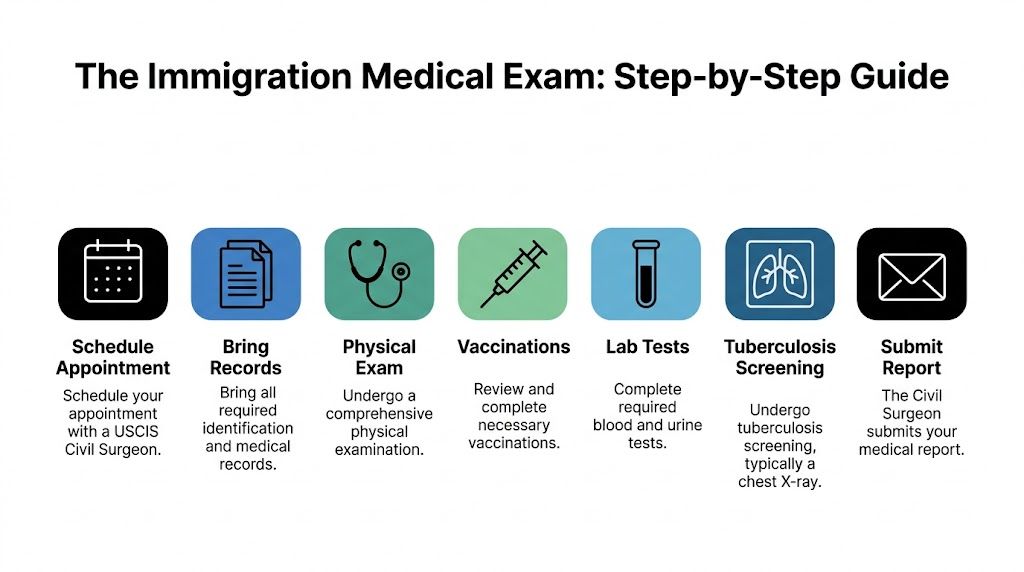
Step 1, identity and paperwork review
The first part is administrative, but it affects everything that follows.
The civil surgeon's office confirms your identity, matches your documents to the medical form, and reviews what you brought. That includes vaccine records, prior chest X-ray reports, old lab results, and proof of treatment for conditions such as latent TB, syphilis, or gonorrhea if you were treated before. If records are incomplete, the exam can still move forward, but the doctor may need to order testing that better paperwork could have avoided.
If you want a plain-language overview from outside a clinic setting, this primer on the Medical Immigration Exam is a useful companion read for first-time applicants.
A practical point many applicants miss: translated records help only if the dates, vaccine names, and patient identity are clear enough to document confidently on Form I-693.
Step 2, the physical exam
The physical exam is routine. It is focused on immigration medical standards, not a search for every minor health issue you have ever had.
The doctor generally checks your eyes, ears, nose, throat, heart, lungs, abdomen, skin, lymph nodes, and extremities. The visit also includes questions about mental health history, substance use, past serious illnesses, and any treatment relevant to public health concerns. If you have scars from prior surgery, a history of trauma, or findings related to female genital mutilation, the exam should still be handled respectfully and clinically. Applicants with that history often worry about judgment. The key concern is accurate documentation and whether any current medical care is needed.
Step 3, communicable disease screening
This part causes the most confusion because the rules are technical and they change over time.
The civil surgeon follows CDC technical instructions for immigration exams. That usually means screening for tuberculosis, syphilis, gonorrhea, and other conditions that must be assessed if symptoms or history raise concern. The exact tests depend on age, history, and current findings.
In practical terms, applicants usually want to know three things:
- TB screening: Many applicants are screened with an IGRA blood test. If the result is positive, or if there is a relevant past history, a chest X-ray may be required.
- Syphilis testing: Blood testing is required for applicants in the age group covered by current instructions. If you were treated before, bring the treatment record.
- Gonorrhea testing: Testing is commonly done with a urine sample or another approved lab method, depending on the clinic setup.
Step 4, TB history and prior positive tests
A prior positive TB test does not block your case by itself. It tells the civil surgeon to sort out whether this is old latent infection, prior treated disease, incomplete history, or a current concern that needs follow-up.
This is one of the places where good records save time. Bring any of the following if you have them:
- Prior IGRA or tuberculin skin test results
- Chest X-ray reports or images
- Records showing latent TB treatment or active TB treatment
- Medication dates and completion notes
- Public health clearance documents, if you were followed by a TB clinic
Old records are still useful.
Without them, the doctor may need to reconstruct the history from memory, repeat parts of the evaluation, or delay final sign-off until the picture is clear. Applicants who had a positive skin test in the past often assume they only need to say so and move on. In practice, the timeline is much smoother when they can show what happened next.
A short explainer may also help if you prefer a video format:
Step 5, mental health and substance use questions
This part makes some applicants tense, especially asylum seekers, torture survivors, and people with a history of depression, anxiety, PTSD, or addiction treatment.
The exam is not designed to penalize someone for getting care. The doctor is assessing whether there is a current physical or mental disorder associated with harmful behavior, or a history that requires specific documentation. If you have seen a therapist, taken psychiatric medication, or completed substance use treatment, honesty helps. Bring discharge papers or a brief treating note if the history is complicated. That can prevent vague charting and unnecessary follow-up questions.
Step 6, final review and sealed form
Once the exam, lab work, and record review are complete, the civil surgeon finishes Form I-693 and prepares the sealed packet.
Do not open that envelope if it is meant for USCIS submission in sealed form. If the office gives you a copy for your records, keep that copy separate. Also check before you leave the clinic that your name, date of birth, and A-number, if applicable, are correct on the paperwork. Small clerical errors are easier to fix the same day than after filing.
If you are waiting on outside lab results, a missing vaccine dose, or old treatment records, the exam may pause at this stage. That is common. It does not mean the case is failing. It usually means the civil surgeon is making sure the form can be signed accurately the first time.
Navigating USCIS Vaccination Requirements
A common appointment goes like this. An applicant arrives with a folder full of records from two countries, a few pharmacy printouts, and a clear memory of having “all the childhood shots.” The exam does not turn on memory. It turns on whether the civil surgeon can document each required vaccine properly on Form I-693.
That is why vaccination issues cause so many avoidable delays. The problem is usually not refusal. It is incomplete proof, records that cannot be interpreted confidently, or uncertainty about whether a past illness or prior dose meets the current CDC technical instructions.
What the civil surgeon can accept
Bring every vaccine record you can find, even if it looks incomplete. A childhood card, school record, government immunization printout, military record, pharmacy history, or translated foreign record can all help if they are legible and tied to you.
The strongest record usually shows:
- Your name or enough identifying information to match the record to you
- The vaccine name or standard abbreviation
- The date each dose was given
- Clear enough writing or translation for the civil surgeon to review it responsibly
A phone photo may be usable if it is sharp and complete. A cropped image with no identifying details usually is not. Verbal history alone does not complete the vaccine portion of the form, even when the applicant is being completely honest.
If you want a clearer overview of how vaccine documentation fits into the Form I-693 medical exam process, review it before your visit and ask the clinic what records they prefer to see in advance.
Missing records, titers, and past disease history
If records are missing, the next question is whether a blood test for immunity, called a titer, is appropriate. Titers can help for some vaccines. They are not a universal substitute for every missing dose.
This is one of the more practical trade-offs in the exam. Titers may save you from repeating certain vaccines you already received years ago, but they can also add cost, lab turnaround time, and occasional confusion if the result is equivocal. For applicants filing on a deadline, getting the vaccine can be faster than waiting on additional testing. For applicants with a strong chance of documented immunity, titers can be the cleaner option.
Past infection matters too, but only in specific ways. A history of chickenpox, for example, may affect how varicella is documented. A past history of tuberculosis is different. TB history does not satisfy vaccine requirements, and it often triggers separate review rules during the medical exam. Applicants with prior positive TB testing, prior treatment, or old chest imaging should bring those records because they can prevent repeated workups and help the civil surgeon document the case correctly.
Which vaccines are reviewed
The required vaccines are age-based and tied to current CDC technical instructions used for immigration exams. The exact list can change over time, and not every vaccine applies to every applicant.
Vaccines commonly reviewed include:
| Vaccine | How it is usually handled |
|---|---|
| Hepatitis A | Required for certain age groups under current instructions |
| Hepatitis B | Commonly reviewed in both children and adults, depending on age rules |
| MMR | Frequently an issue for adults with incomplete childhood records |
| Varicella | May be documented through records, acceptable history, or other allowed evidence |
| Polio | Foreign records often need careful review for dose timing and notation |
| Tdap or other tetanus-containing vaccines | Reviewed by age and interval rules |
| Influenza | Seasonal requirement when applicable |
| Other CDC-required vaccines | Applied based on age and current immigration instructions |
COVID-19 is not currently required for the immigration medical exam, as noted earlier in the article. The civil surgeon still has to review all other vaccines that apply on the exam date.
For general background outside the immigration context, this immunization schedule for adults can help. For Form I-693, the civil surgeon must follow immigration-specific rules, not a general wellness checklist.
Situations that need extra care
Some applicants need a more careful vaccine review.
Asylum seekers often arrive without complete records because documents were lost during flight, confiscated, or left behind for safety reasons. That history is common. It does not create a penalty by itself, but it does mean the vaccine section often needs a practical plan, such as replacing clearly missing doses or using titers where permitted.
Applicants who are survivors of FGM, sexual violence, torture, or severe trauma may find injections and genital or body-related medical settings distressing. Vaccines are still part of the exam when required, but a good clinic should explain what is needed, ask permission before each step, and avoid rushing a frightened patient through consent. If trauma history affects your ability to complete part of the visit, say so early. That gives the staff time to respond appropriately.
Pregnancy, immunosuppression, and true medical contraindications also change the discussion. The answer is not to skip documentation. The answer is to document the reason correctly so the form reflects why a vaccine was not given.
What prevents delays
Applicants do best when they treat vaccines as a records problem first and a shots problem second.
Use this checklist before the appointment:
- Gather every vaccine record you have, including partial and foreign records
- Get translations if the vaccine names or dates are not readable to the clinic
- Ask the office ahead of time whether they review records before the visit
- Ask whether titers are available and which ones the civil surgeon accepts
- Bring old TB records if you have a prior positive test, treatment history, or chest X-ray
- Mention pregnancy, immune conditions, or prior serious vaccine reactions before the appointment
One last practical point. Do not assume that getting extra vaccines is always harmless from an immigration paperwork standpoint. It is often acceptable, but unnecessary repeat doses can cost money and add discomfort. Good records can spare you that.
Costs, Timelines, and Managing Your I-693 Form
A common mistake happens at the very end of an otherwise well-prepared case. The applicant books the exam too late, arrives without records, or assumes the sealed I-693 will be ready the same day. Then the filing stalls over logistics, not medical eligibility.
What you’re usually paying for
The exam fee usually covers the civil surgeon visit, the required review, and completion of the form. It often does not include every added item that comes up during the process.
Extra charges may apply for:
- Vaccines given at the visit
- Blood tests
- TB follow-up, such as a chest X-ray when indicated
- Record translation or outside record retrieval
- Repeat visits if the form cannot be completed the first day
This is why I tell applicants to ask one very specific question before booking: “What is included in your quoted price, and what triggers an added charge?” A low base fee can become expensive if the office bills separately for labs, vaccines, and TB workup.
Timing the exam correctly
For adjustment applicants, timing is now tied closely to filing strategy. If you wait until the last minute, you may end up choosing between delaying the I-485 package or filing with an incomplete medical packet if the current filing rules require concurrent submission.
The practical trade-off looks like this:
| Timing choice | Likely result |
|---|---|
| Schedule too late | You may miss your target filing date |
| Schedule before gathering records | The office may hold the form open for follow-up |
| Schedule after checking vaccine and TB history | The visit is more likely to finish without extra delays |
Delays usually come from predictable issues. Missing vaccine records is one. A past positive TB test is another. Applicants often say, “I already had this checked years ago,” and that history may help, but the civil surgeon still has to document the case under current immigration rules. Bring prior TB test results, chest X-rays, and proof of treatment if you have them. That can save days of back-and-forth and sometimes prevent repeat work.
Same-day sealing is possible in some offices, but it should never be assumed. If labs are pending, vaccines are needed, or TB follow-up is required, the form stays unsealed until every required part is complete. Ask the clinic how they handle pending results, whether they use on-site labs or outside labs, and how they contact you if something needs attention.
If you want a plain-language overview before the visit, review this guide to Form I-693 medical examination paperwork.
Handling the sealed form
Once the form is complete, the clinic will seal it for submission or explain its handoff process.
Do not open the sealed envelope.
Ask for a personal copy before you leave, if the office offers one. Keep it with your immigration records. That copy is useful if USCIS later issues a request for evidence, if your package is lost in transit, or if you need to confirm what was recorded about vaccines, TB history, pregnancy, or another special situation.
One last practical point. Asylum seekers, applicants with complicated trauma histories, and survivors of FGM or other gender-based harm sometimes need more time for follow-up records or careful documentation. That does not usually change the fee structure by itself, but it can change the timeline. If that applies to you, say so when booking. A clinic that knows this early can schedule enough time and explain what documents to bring so the I-693 process does not become harder than it already is.
Special Considerations and Waivers
A common scenario is this. An applicant arrives with an old positive TB test, partial vaccine records from another country, and a mental health history they are afraid to mention because they think it will ruin the case. This part of the exam usually causes more worry than the physical exam itself, but most problems can be handled if the history is documented clearly and early.
Trauma history, asylum cases, and mental health documentation
Asylum seekers, torture survivors, and applicants with PTSD often worry that any mental health diagnosis will create an immigration problem. The diagnosis alone is usually not the issue. The civil surgeon must determine whether there is a condition linked to harmful behavior and record the facts accurately on the immigration form.
That distinction matters.
If you have a trauma history, bring records that show treatment, stability, and current functioning. Good documentation can prevent vague or incomplete notes that later raise questions for USCIS or for your immigration attorney.
Helpful records often include:
- Psychiatric or psychological evaluations
- Hospital discharge records, if relevant
- A current medication list
- Therapist or psychiatrist letters
- Records showing treatment progress or the absence of harmful behavior, when applicable
Applicants sometimes avoid the topic because they feel ashamed, fear being misunderstood, or do not want to relive painful events. In practice, partial disclosure usually creates more work later. A careful, fact-based explanation from the start is easier to document than trying to correct an incomplete I-693 record after filing.
Prior TB history and old treatment records
A past positive TB test does not automatically mean a new problem, but it does change what the civil surgeon has to review. Bring any prior chest X-ray reports, treatment records, medication dates, or public health clearance letters. Without those records, the office may need extra testing or may have to wait for new documentation before the form can be completed.
This is one of the most common avoidable delays.
Applicants who were treated outside the United States often have real records, but they are scattered across old clinics, translated incompletely, or missing treatment dates. Even partial records are worth bringing. They can help the civil surgeon determine what still needs to be documented and what does not need to be repeated.
Vaccine gaps, foreign records, and special exceptions
Vaccine records from another country are often usable if they are clear enough to identify the vaccine, the date given, and the age at administration. Bring the original record and any translation you have. If the record is incomplete, the civil surgeon may be able to use acceptable documentation, order titers in some cases, or recommend repeating certain vaccines instead of spending weeks chasing paperwork.
There are also situations where a vaccine is not medically appropriate, such as pregnancy, a true contraindication, or an age-based exception. Those are handled through proper notation on the I-693, not by leaving the section blank.
FGM survivors and exam planning
Survivors of female genital mutilation often need a slower, more careful exam process. That should be addressed when the visit is scheduled, not while the patient is already in the room.
A well-run clinic explains what parts of the exam are required, asks permission before sensitive portions of the visit, and limits documentation to what the immigration medical exam requires. If outside gynecology, mental health, or trauma records will help avoid repeating a painful history in detail, gather those before the appointment.
When a waiver may apply
Some health-related findings require more than documentation on Form I-693. They may also raise a waiver question, often involving Form I-601, depending on the applicant’s immigration category and the specific ground involved. The medical exam does not decide the waiver by itself, but the wording and supporting records must be accurate because USCIS and legal counsel may rely on them later.
Disability-related questions can also involve a different form entirely. Applicants dealing with naturalization and disability exceptions should review this explanation of the USCIS disability waiver and Form N-648 so it is not confused with the I-693 medical exam.
The practical rule is simple. Bring records early, disclose sensitive history carefully but truthfully, and ask the clinic whether your case needs extra time for review before the form can be finalized.
Frequently Asked Questions
What happens if I have a positive TB test
A positive TB test doesn’t automatically mean you fail the immigration medical exam. It usually means the civil surgeon must review your history, determine whether more testing is needed, and document the result correctly. If you’ve had prior treatment, bring those records.
Can I use my own doctor for the exam
Usually, no. Your regular doctor can be helpful for records, medication lists, or past treatment notes, but Form I-693 must be completed by a USCIS-designated civil surgeon for adjustment of status cases.
What if I don’t have my childhood vaccine records
That’s common. The civil surgeon reviews what you do have and decides whether you need vaccines, acceptable documentation, or titer testing to prove immunity. Missing records are manageable, but they should be addressed early because they often cause delays.
Does a mental health diagnosis automatically create a problem
No. A diagnosis alone is not the same as a finding of inadmissibility. The issue is whether there is a condition associated with harmful behavior and whether the documentation is complete. Applicants with PTSD, prior trauma, or treatment history should bring supporting records rather than avoiding the topic.
Can the form be rejected if I open the envelope
Yes, it can. If the civil surgeon gives you a sealed I-693 packet, leave it sealed for USCIS. Opening it can force you to repeat the exam paperwork.
If you need an immigration medical exam in Maryland, Maryland Primary and Urgent Care offers USCIS immigration medical exams through a designated civil surgeon, with scheduling, lab coordination, and follow-up guidance designed to help applicants complete Form I-693 correctly the first time.