TL;DR: After a car accident, your first step is to ensure safety and call 911. Your second, equally important step is to get a medical evaluation at a specialized car accident injury clinic within 24 to 72 hours, even if you feel fine. Motor vehicle crashes lead to an estimated 3.8 million emergency department visits annually in the United States, or 11.6 visits per 1,000 people, which is why fast evaluation matters for both health and documentation.
A lot of people searching car accident injury clinic near me are in the same situation. The car may still be drivable, the pain may seem minor, and everyone around them may be saying to rest and “see how you feel tomorrow.”
That’s exactly where mistakes happen. Some injuries show up later, and delayed care also makes insurance and claim paperwork harder than it needs to be.
If you’re trying to decide what to do next, keep it simple. Handle safety first, get evaluated promptly, and make sure your medical record starts early and accurately.
Table of Contents
- Just Had a Car Accident? Here’s What to Do First
- Why You Need a Specialized Auto Accident Clinic
- How to Choose the Right Injury Clinic Near You
- Preparing for Your Visit What to Bring and Document
- What to Expect Medically Diagnosis and Treatment
- Your Next Steps to Recovery in Maryland
- Frequently Asked Questions About Car Accident Injuries
- Should I still get checked if I feel okay
- Does treatment only matter for health, or also for insurance
- What if I can’t get to a clinic during work hours
- What should I tell the doctor on the first visit
- Can telemedicine replace an in-person exam after a crash
- What if the clinic staff doesn’t explain billing or paperwork clearly
Just Had a Car Accident? Here’s What to Do First
Start with safety. Move to a safer location if you can do so without increasing risk, call 911, and wait for emergency responders if anyone is injured or the scene is unsafe. Then exchange insurance and contact information, take photos, and note the time, location, and what happened while it’s still fresh.

At the scene, keep your checklist short
- Make the area safer: Turn on hazard lights and follow police instructions.
- Call 911: Don’t assume a minor crash means no injury.
- Exchange details: Get the other driver’s name, insurance information, vehicle details, and contact information.
- Document the scene: Take photos of vehicles, license plates, road position, and visible injuries.
- Avoid casual medical guesses: “I’m probably fine” is not a diagnosis.
In the United States, motor vehicle crashes lead to an estimated 3.8 million emergency department visits annually, a rate of 11.6 visits per 1,000 people, which shows how common these injuries are and why prompt assessment matters (CDC data brief on crash-related ED visits).
Practical rule: If your body took the force of a collision, get examined even when symptoms seem delayed, mild, or confusing.
A general post-crash checklist can also help if your mind is racing. This step-by-step resource on What to Do After a Car Accident: A Step-by-Step Guide is useful for organizing the first few hours.
The next move is medical, not just administrative
The most important thing after leaving the scene is getting evaluated within 24 to 72 hours. That timeline matters because pain, stiffness, headaches, dizziness, and back symptoms often don’t peak immediately.
A proper exam also creates the first medical record connecting your symptoms to the crash. If you want a clear explanation of why early evaluation matters even after a “small” collision, this guide on why to see a doctor after a car accident covers the basics well.
Why You Need a Specialized Auto Accident Clinic
The emergency room is built to rule out emergencies. That’s important, but it isn’t the same as managing the full course of a crash injury.
A primary care office may know your history well, but many family practices aren’t set up for same-day accident evaluations, coordinated rehab, or claim-focused documentation. A specialized auto accident clinic usually is.
The difference is in the follow-through
After a crash, the question isn’t only “Am I in danger right now?” It’s also “What injuries could evolve over the next few days, and how will they be tracked?”
Specialized clinics tend to focus on three things that patients need:
- Hidden injury detection: Neck strain, back pain, soft tissue injury, headache patterns, and movement limits often need a more focused musculoskeletal exam.
- Documentation that matches the event: Your history, exam findings, symptom progression, and treatment plan need to be recorded clearly from the start.
- Coordinated care: Patients do better when evaluation, follow-up, and rehab planning connect instead of living in separate silos.
While crash fatalities have declined, the volume of non-fatal injuries remains a major public health issue, and some states have prompt-treatment rules that can affect benefits, including Florida’s 14-day rule for preserving certain insurance benefits (National Safety Council overview).
A rushed exam can miss the issue that causes the most trouble two weeks later.
What works and what usually doesn’t
What works is a clinic that treats accident care as a sequence, not a one-time visit. That means a detailed first evaluation, a documented treatment plan, scheduled reassessment, and a clear explanation of how billing and records will be handled.
What doesn’t work is bouncing between locations with no single clinician tracking the whole picture. Patients often tell us they left one visit with a pain medication recommendation but no explanation of what to monitor, no follow-up plan, and no idea what paperwork the insurer would ask for.
If you’re searching for a car accident injury clinic near me, don’t choose based only on distance. Choose based on whether the clinic understands both recovery and documentation.
How to Choose the Right Injury Clinic Near You
The best local clinic isn’t just the closest pin on a map. It’s the one that can see you quickly, document the injury correctly, and keep treatment moving without making you chase answers.
Questions to ask before you book
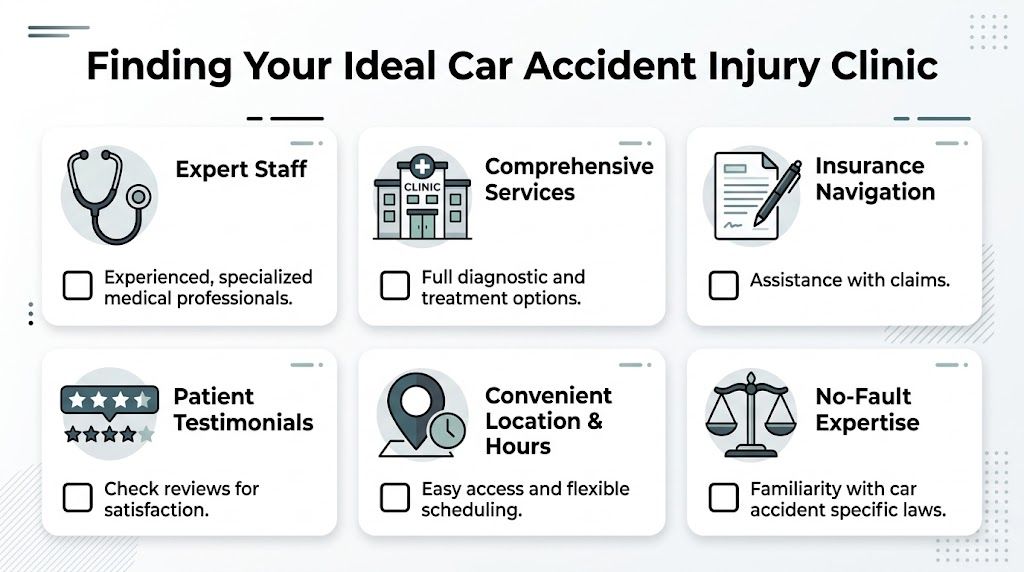
Use this checklist when comparing nearby options:
- Can they see you quickly: Ask whether they offer walk-in care or same-day appointments. Delays create clinical and paperwork problems.
- Do they handle accident cases regularly: A clinic doesn’t need flashy language. It does need a routine for crash-related exams, follow-ups, and records.
- Is diagnostic support available: On-site labs or imaging coordination can save time when symptoms change.
- Will they explain insurance logistics: If the front desk can’t explain what information they need from your auto policy, that’s a warning sign.
- Do they offer more than one treatment pathway: Recovery often needs reassessment, not a single fixed service.
- Can they reduce access barriers: Transportation, schedule conflicts, childcare, and language support matter more than most websites admit.
Many patients face barriers such as transportation problems, work-hour conflicts, or language differences that delay care, and many clinic websites don’t address those obstacles directly. Clinics that offer options like walk-in hours, telemedicine, and multilingual support fill a real gap for diverse communities (analysis of access barriers in local clinic content).
A quick comparison table
| What to check | Why it matters |
|---|---|
| Walk-in or same-day access | Crash injuries shouldn’t wait for a routine slot |
| Clear documentation process | Your chart needs to support both treatment and claims |
| Insurance coordination help | Patients shouldn’t have to guess how billing works |
| Follow-up availability | Symptoms often change after the first visit |
| Remote options when appropriate | Useful when travel, work, or mobility is a barrier |
If a clinic talks only about treatment and says nothing about access, paperwork, or follow-up, keep looking.
One local option that fits many of these practical criteria is urgent care versus ER guidance from Maryland Primary and Urgent Care, especially for patients deciding whether they need hospital-level care or a focused urgent evaluation after a crash.
Preparing for Your Visit What to Bring and Document
A lot of claim problems start before treatment ever begins. Patients show up with pain, but not with the information that helps a clinic build a complete chart.
That’s fixable. Bring the basics, and write down your symptoms before the appointment if you can.
Bring these items to the clinic
A common point of failure after a crash is poor guidance about medical documentation and billing. Many clinics describe treatment but don’t explain what paperwork patients need for personal injury claims, how PIP-related billing works, or when documentation must be submitted, which can lead to confusion and possible claim problems (discussion of this documentation gap).
| Information to Gather | Example / What to Note |
|---|---|
| Photo ID | Driver’s license or other government ID |
| Auto insurance card | Policy details tied to the vehicle or claim |
| Health insurance card | Bring it even if auto coverage may apply first |
| Police report number | Case or incident number if available |
| Accident photos | Vehicle damage, road position, visible injuries |
| Medication list | Current prescriptions and any blood thinners or pain medicines |
| Prior injury history | Prior neck, back, shoulder, or headache issues |
| Employer details if relevant | If work limitations may need documentation |
Document symptoms like a witness, not like a guess
Don’t say only “my neck hurts.” Give the clinic a usable record.
Write down:
- Where the pain is: Neck, mid-back, low back, shoulder, wrist, knee, jaw, chest.
- What it feels like: Sharp, aching, burning, numbness, tingling, pressure, stiffness.
- When it started: Right away, later that night, the next morning.
- What makes it worse: Turning your head, sitting, standing, walking, lifting, sleeping.
- How it affects daily life: Driving, dressing, working, concentrating, sleeping.
Bring a short timeline. “Crash at 4 p.m., headache by evening, neck stiffness next morning” is more useful than “I’ve been sore.”
Ask these questions at check-in
Not every clinic volunteers the answers, so ask directly:
- What insurance information do you need from me today?
- Who should receive my visit records if I need them for a claim?
- How will follow-up visits be documented?
- If new symptoms appear, how should I report them?
Clear answers early usually prevent avoidable disputes later.
What to Expect Medically Diagnosis and Treatment
Your first visit should feel organized, not rushed. The clinician should connect the mechanics of the crash to the symptoms you have now, then decide what needs immediate treatment, what needs monitoring, and what needs follow-up.

What usually happens at the first appointment
Expect four core parts.
First, there’s a history. The clinician will ask how the crash happened, where you were seated, whether you were restrained, what symptoms began first, and what has changed since then.
Second, there’s a physical exam. That often includes neck and back movement, tenderness, neurologic checks, strength, gait, and focused examination of painful areas.
Third, there’s a diagnostic decision. Some patients need immediate imaging or additional testing. Others need careful observation, a treatment plan, and a clear return plan if symptoms worsen.
Fourth, there’s a care plan. You should leave knowing what the working diagnosis is, what treatment starts now, what activity changes are recommended, and when you’ll be reassessed.
Recovery usually happens in phases
Effective auto injury clinics use a phased model. Phase 1 (0 to 2 weeks) focuses on acute pain control. Phase 2 (2 to 6 weeks) uses physical therapy to restore stability. Phase 3 (6+ weeks) focuses on functional reintegration, and this structured approach can lead to a 90% return-to-work rate within 3 months for soft-tissue injuries (phased recovery model reference).
That progression matters because accident recovery is rarely linear. Early treatment aims to calm pain and inflammation. Later treatment aims to restore motion, strength, and daily function without triggering setbacks.
Here’s a short overview of how post-accident billing questions often fit into the care process, especially for patients trying to understand liability and payment order: who pays medical bills after a car accident.
Before moving into rehab, it helps to understand what a coordinated care pathway can look like in practice:
What good treatment planning looks like
Good treatment planning is specific. It identifies current problems, sets follow-up timing, and explains what would change the plan.
That often includes:
- Symptom control now: Pain management, activity guidance, and targeted therapy recommendations.
- Recheck points: A defined visit schedule to monitor whether symptoms are improving, spreading, or interfering with work and sleep.
- Escalation rules: Clear instructions on when worsening pain, neurologic symptoms, or new complaints require urgent reassessment.
Patients feel less anxious when they know the process. Clinicians make better decisions when the process is documented.
Your Next Steps to Recovery in Maryland
Once the immediate crisis is over, the goal is straightforward. Get examined promptly, follow the treatment plan, and keep your medical record consistent from the first visit forward.
For adults in Lanham and Prince George’s County, that usually means choosing a clinic that can handle urgent evaluation, ongoing follow-up, and practical access issues without sending you in circles. If travel, work schedule, or symptom flare-ups make in-person follow-up harder, telemedicine services in Maryland can also help with selected follow-up needs when appropriate.
If you need one option to consider locally, Maryland Primary and Urgent Care in Lanham offers walk-in urgent care, same-day appointments, on-site diagnostic support, and a dedicated auto accident clinic as part of its broader adult care services. That combination is useful for patients who need both treatment and continuity.
The right next step isn’t waiting to see if pain becomes serious enough. The right next step is getting evaluated while the record is still clear.
If you’re searching for a car accident injury clinic near me, speed and organization matter more than marketing language. Look for a clinic that can examine you promptly, explain the process plainly, and keep your care moving.
Frequently Asked Questions About Car Accident Injuries
Should I still get checked if I feel okay
Yes. Many crash injuries don’t declare themselves fully at the scene. People often notice symptoms later when adrenaline wears off, sleep is disrupted, or normal movement returns.
Does treatment only matter for health, or also for insurance
Both. Prompt care helps identify injuries early, and it also creates the documentation insurers often expect. Waiting makes it harder to show when symptoms started and how they changed.
What if I can’t get to a clinic during work hours
Look for clinics that offer walk-in availability, same-day scheduling, or remote follow-up when appropriate. Access barriers are real, and a workable schedule is part of good medical care.
What should I tell the doctor on the first visit
Be specific about where you hurt, when symptoms began, and how the pain affects sleep, driving, work, lifting, or concentration. Small details matter because they shape both diagnosis and charting.
Can telemedicine replace an in-person exam after a crash
Not always. An in-person exam is often needed to check movement, tenderness, strength, and neurologic findings. Telemedicine can still be useful for selected follow-up questions, care coordination, or symptom updates when a clinician decides it fits the situation.
What if the clinic staff doesn’t explain billing or paperwork clearly
Ask direct questions before you leave. You should understand what insurance information was collected, whether additional documents are needed, and how to request copies of your records if needed for a claim or attorney.
If you need prompt evaluation after a crash, Maryland Primary and Urgent Care offers adult urgent care and auto accident care in Lanham with same-day scheduling, walk-in availability, and coordinated follow-up. Book online or call the clinic so your injuries, treatment plan, and documentation start on time.