You wake up with a fever, body aches, and a sore throat. Your regular doctor’s office doesn’t have an opening this morning. You’re uncomfortable, you need an answer, and you don’t want to choose the wrong place and waste time or money.
That’s where many patients get stuck. They know urgent care and primary care are both useful, but the difference between urgent care and primary care isn’t always obvious when you’re sick, worried, or trying to help a child, parent, or spouse decide what to do next.
The good news is that these two types of care aren’t competitors. They serve different jobs. One is built for ongoing health management. The other is built for same-day, unexpected problems. Knowing which one fits your situation can make care faster, less fragmented, and more effective over time.
Table of Contents
- Urgent Care or Primary Care Which Do You Need
- What Is Primary Care Your Healthcare Home Base
- What Is Urgent Care For Immediate Unexpected Needs
- Urgent Care vs Primary Care A Detailed Comparison
- When to Choose Urgent Care vs Primary Care
- The Best of Both Worlds An Integrated Approach
Urgent Care or Primary Care Which Do You Need
A common real-life example is simple. You wake up on a weekday with a bad cough and fever. If you already have a doctor who knows your medications, allergies, blood pressure history, and past illnesses, primary care may be the best place to start. If it’s evening, the office is closed, or you need to be seen quickly for a non-life-threatening issue, urgent care may make more sense.

The broad pattern in the U.S. shows why both matter. According to the CDC’s National Center for Health Statistics, 50.3% of the 1.0 billion annual physician visits in the U.S. are to primary care physicians, which shows how central primary care remains to everyday healthcare. The Urgent Care Association reports that 26.5% of adults visited an urgent care center in a year, reflecting how often people need fast help for immediate problems when primary care isn’t available (CDC fast facts on physician visits).
The quickest way to think about it
- Primary care fits ongoing health needs. Annual visits, medication review, blood pressure follow-up, diabetes care, preventive screening, and long-term planning belong here.
- Urgent care fits new problems that can’t wait. A sudden ear infection, a painful UTI, a mild sprain, or a weekend fever often fit this setting.
- Neither replaces the emergency room. Severe chest pain, major breathing trouble, or heavy bleeding need emergency care.
Practical rule: If the problem is part of your bigger health story, primary care is usually best. If it’s a new issue that needs attention today and isn’t an emergency, urgent care is often the right stop.
Most confusion happens because patients are trying to solve two problems at once. They want relief now, and they also want care that makes sense long term. Those are not always the same thing. The right choice depends on whether your main need is speed, continuity, or both.
What Is Primary Care Your Healthcare Home Base
Primary care is your healthcare home base. It’s where your care becomes connected instead of scattered.
A primary care clinician does more than treat a sore throat or refill a prescription. This is the place where someone tracks your health over time, notices patterns, and helps prevent small issues from turning into larger ones.

What primary care actually does
For many adults, primary care includes:
- Preventive visits and screenings. Annual exams, blood pressure checks, cholesterol review, vaccines, and age-appropriate screening.
- Chronic disease management. Ongoing follow-up for diabetes, hypertension, heart disease, asthma, and similar conditions.
- Medication oversight. Reviewing side effects, interactions, refill timing, and whether a treatment plan is still working.
- Specialist coordination. Helping you make sense of referrals, testing, and what each specialist adds to the full picture.
The most valuable part is continuity. One visit rarely tells the whole story. A trend across several visits often does.
Why continuity matters
If you’ve ever seen different clinicians in different places for related symptoms, you know how easy it is for details to get lost. One doctor hears about fatigue. Another treats high blood pressure. A third sees abnormal lab work. Primary care pulls those pieces together.
That’s especially important when you live with chronic conditions. Someone managing diabetes or hypertension doesn’t just need treatment when things flare up. They need regular follow-up, adjustment, and prevention.
Urgent care visits often involve $20–$50 copays, while preventive primary care exams are typically covered with a $0 copay under in-network plans. For many patients, that makes primary care the better first stop for routine prevention and long-term management (comparison of urgent care and primary care costs).
A good primary care relationship often saves trouble before it starts. The benefit isn’t only the visit itself. It’s the record, the follow-up, and the judgment built over time.
What works well in primary care
Primary care works best when patients use it proactively, not only when they feel sick.
A practical routine looks like this:
- Choose one clinician or practice for your regular care. If you need help narrowing that down, this guide on how to choose a primary care physician covers the factors that matter most.
- Bring your medication list every time. Don’t rely on memory, especially if prescriptions changed recently.
- Use visits to review trends. Blood pressure, weight changes, sleep, mood, glucose readings, and recurring symptoms all matter more in sequence than in isolation.
What primary care does not do well
Primary care is not always the fastest option for a same-day surprise problem. Offices may have scheduled slots, limited evening hours, or full calendars. That’s where urgent care becomes useful.
But for prevention, chronic disease management, and care coordination, primary care remains the strongest foundation. It’s the setting built to know you, not just your symptoms today.
What Is Urgent Care For Immediate Unexpected Needs
Urgent care fills the space between a scheduled doctor’s visit and the emergency room. It’s designed for prompt treatment of non-life-threatening problems that need attention soon.
Patients often go to urgent care for a weekend earache, a painful sore throat, a rash that appeared overnight, mild flu symptoms, a sprain, or burning with urination. The central advantage is access. You can usually walk in, and many locations offer evening or weekend care.
Problems urgent care handles well
Urgent care is usually appropriate for issues such as:
- Minor illnesses. Fever, cough, cold symptoms, sinus discomfort, sore throat, nausea, or mild stomach illness.
- Minor injuries. Sprains, strains, small cuts, and uncomplicated bumps or falls.
- Sudden but lower-risk symptoms. Ear pain, urinary symptoms, pink eye, or a rash without severe systemic symptoms.
Urgent care is problem-focused. The visit is about answering one immediate question. What is this, and what do I need to do now?
Why patients choose urgent care
Convenience is the obvious reason. If your doctor’s office is closed or booked, urgent care can be the right next step.
There’s also a practical insurance angle. Many patients aren’t sure which services count as preventive versus problem-based. If you want a simple overview before scheduling routine care, this explanation of what is covered under preventive care can help you understand where preventive benefits usually apply.
Urgent care is helpful when waiting would create more discomfort, more missed work, or more uncertainty. It often prevents unnecessary emergency room use for conditions that are uncomfortable but not dangerous.
Where urgent care falls short
Urgent care is not built for the long view. It usually doesn’t function as the place where someone follows your blood pressure over time, reviews months of fatigue, adjusts long-term medications, or manages a complex chronic illness strategy.
That limitation doesn’t make urgent care less valuable. It means it works best when used for the right task.
Urgent care is strongest when the question is immediate. Primary care is strongest when the question is ongoing.
Patients run into trouble when they use urgent care as their only source of healthcare. They may get treatment for each new problem, but no one is stepping back to look for patterns, check prevention needs, or connect the dots across visits.
This distinction highlights the difference between urgent care and primary care. One solves today’s problem. The other manages your health across years.
Urgent Care vs Primary Care A Detailed Comparison
The easiest way to understand the difference between urgent care and primary care is to compare them side by side. They overlap in some everyday services, but they are organized around different priorities.
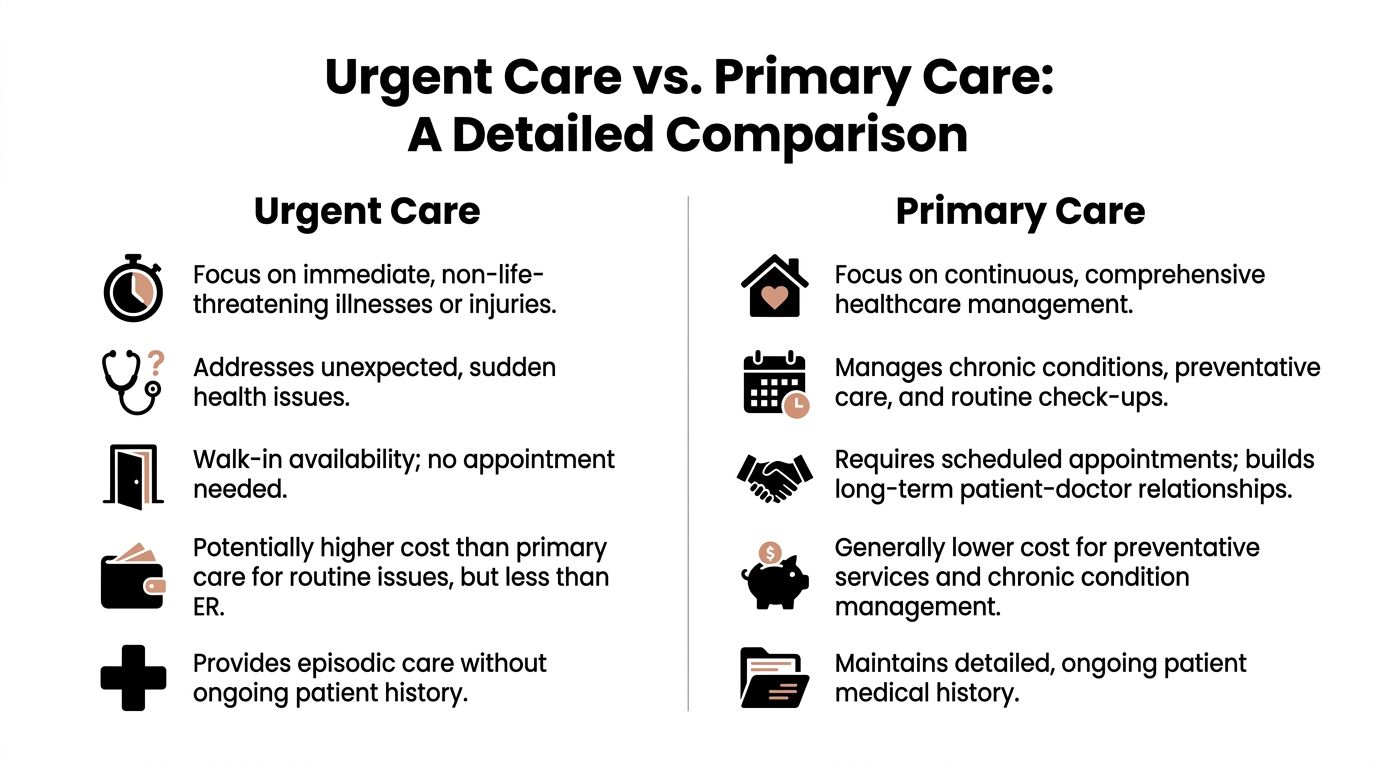
Primary Care vs. Urgent Care at a Glance
| Feature | Primary Care | Urgent Care |
|---|---|---|
| Main purpose | Long-term health management | Immediate care for unexpected non-emergency issues |
| Visit style | Scheduled, relationship-based | Walk-in, episodic |
| Best for | Prevention, chronic disease, follow-up, medication review | New symptoms, minor illness, minor injury, after-hours needs |
| Knowledge of your history | Usually broad and longitudinal | Often limited to the current visit |
| Cost pattern | Preventive care may be covered under in-network benefits | Per-visit copay commonly applies |
| Follow-up | Built into ongoing care | Often depends on what happens after the visit |
| When not enough | True emergencies or some immediate after-hours issues | Severe symptoms, complex long-term management |
The relationship is different
Primary care is relationship-based. That matters more than many patients realize.
If you have high blood pressure, weight changes, sleep problems, and fatigue, those may be linked. A primary care clinician can track that over time. Urgent care may treat one visit well, but it usually won’t own the whole pattern.
Urgent care is episodic by design. That’s appropriate for a sudden sore throat or ankle twist. It’s less effective for concerns that need repeat assessment, comparison with older records, or medication strategy.
Speed and satisfaction are not the same as completeness
Urgent care often feels faster, and for many acute concerns, that’s exactly what patients need. A comparative study found that urgent care visits were significantly shorter than ER visits, averaging 104 minutes versus 179 minutes, but post-visit uncertainty was also higher at 32% versus 25%, which suggests that speed can come with a need for clearer follow-up instructions (prospective comparative study on urgent care and ER outcomes).
That doesn’t mean urgent care is poor care. It means the visit has to answer the right question. Fast treatment works well for straightforward issues. It’s less satisfying when the patient really needs broader context, a deeper medication review, or a follow-up plan tied to chronic disease.
Cost and access pull in different directions
Primary care tends to be the better fit for routine prevention and stable chronic disease work. Urgent care tends to win on convenience.
This is why patients often end up balancing two priorities:
- Access today
- Continuity over time
For some symptoms, a same-day walk-in visit is exactly right. For others, it’s better to wait a short time for the clinician who already knows your case. If you’re deciding between urgent care and a higher-acuity setting, this page on urgent care vs ER can help clarify that line.
Fast care is not always complete care. Complete care is not always fast care. The right setting depends on which problem you’re solving.
What works best in real life
The strongest healthcare routine usually uses both settings appropriately. Patients do best when they keep a primary care home base and use urgent care as backup for timing, not as a full replacement.
That combination improves convenience without giving up continuity. It also lowers the chance that an isolated visit becomes a disconnected one.
When to Choose Urgent Care vs Primary Care
A practical decision often comes down to one question. Do you need care today for a new problem, or do you need care from someone who follows your health over time?

Choose primary care when the issue is part of an ongoing plan
Primary care is usually the right call for concerns like:
- Medication refills and review. Especially if side effects, blood pressure changes, or dose adjustments are part of the issue.
- Chronic condition follow-up. Diabetes, hypertension, asthma, heart disease, and recurring symptoms belong here.
- Preventive care. Annual exams, routine screening, vaccines, and wellness planning fit best in this setting.
- Symptoms that have been developing over time. Fatigue, headaches, changing sleep, digestive patterns, or repeat complaints need context.
Choose urgent care when the problem is sudden and can’t wait
Urgent care often makes sense for:
- A new illness that started quickly. Fever, sore throat, cough, ear pain, or urinary symptoms that need timely evaluation.
- A minor injury. A sprain, strain, or small cut that likely needs treatment but not emergency care.
- A problem that happens outside office hours. Evening, weekend, or same-day concerns often land here.
The money side can be more complicated than people expect. A patient with hypertension may use primary care for routine management and still need urgent care for an acute concern. That’s why total cost of care isn’t always obvious from one visit alone, especially for chronic conditions (discussion of the cost complexity between urgent and primary care).
Go to the ER for dangerous or potentially life-threatening symptoms
Seek emergency care right away for severe symptoms such as:
- Chest pain
- Trouble breathing
- Heavy or uncontrolled bleeding
- Sudden weakness, fainting, or confusion
- Serious injuries or severe worsening of symptoms
A short visual explainer can help if you’re trying to make this decision under stress.
A simple triage habit that helps
If you already have a primary care office, contact them first when possible. Many practices can tell you whether you should come in, use urgent care, or go straight to the ER.
If the symptom is alarming, don’t spend too much time debating the perfect setting. Safety comes first.
Patients make the best decisions when they have a plan before they need one. Keep your doctor’s number saved, know the nearest urgent care location, and know which symptoms should never wait.
The Best of Both Worlds An Integrated Approach
The hardest part of modern healthcare isn’t always getting seen. It’s making sure one visit connects to the next.
A patient goes to urgent care for a cough, gets medication, and improves. A month later, the primary care office doesn’t have the urgent care note. Or the urgent care clinician doesn’t know the patient’s full medication list, chronic conditions, or recent test results. That’s where fragmentation starts.
Where separate systems often break down
A major gap in typical care is the lack of automatic record transfer between urgent care and a PCP. That creates risk when the urgent care team doesn’t fully know a patient’s chronic conditions or medications. An integrated model that shares one electronic health record directly addresses that problem (discussion of care fragmentation between urgent care and primary care).
That matters even more for patients with layered medical needs, including:
- Adults with chronic disease. Blood pressure, diabetes, heart disease, and medication changes all require follow-through.
- Patients needing specialized exams. Immigration medical exams, pre-employment physicals, and preoperative assessments generate information that should stay in one chart.
- People recovering from accidents or acute episodes. Follow-up matters as much as the initial visit.
Why an integrated model works better
When primary and urgent care operate inside one coordinated practice, several things get easier.
First, the clinician seeing you for a same-day issue can work from your existing record. That reduces guesswork.
Second, follow-up becomes more realistic. If your urgent visit shows a blood pressure concern, abnormal finding, or unresolved symptom, your next step can connect directly to ongoing care rather than starting over.
Third, the patient experience becomes simpler. You’re not acting as the messenger between disconnected offices.
Here’s what tends to work best in integrated care:
- One record for both visit types. Your medications, history, prior labs, and recent treatment are visible in one place.
- Smoother follow-up. Acute treatment can transition into chronic management or preventive review without losing context.
- Broader convenience. Same-day urgent needs and scheduled primary care can happen within one system.
- Less repetition. Patients don’t have to keep retelling the same medical history at every new visit.
Why this matters in everyday practice
In family medicine, many problems don’t stay in one box. A patient may come in for a cough and also need blood pressure follow-up. Someone may schedule a physical and mention chest discomfort that needs prompt evaluation. A person seeking a travel visit may also need overdue preventive care. Real life doesn’t separate problems as neatly as clinic labels do.
That’s why the integrated approach is so practical. It respects the difference between urgent care and primary care without forcing patients to choose between speed and continuity.
For patients who want one place that can handle same-day visits, chronic disease management, on-site lab support, travel health, immigration medical exams, auto accident follow-up, and routine preventive care, an integrated clinic model offers a more coherent experience. If you want a closer look at that model, this overview of the advantages of Maryland Primary Care Urgent Care Clinic explains how coordinated services can reduce friction for patients.
The best healthcare setup isn’t urgent care alone or primary care alone. It’s a system where each does its own job and the information still stays connected.
Choosing the right site of care matters. Choosing a system that keeps your care unified matters even more.
If you want care that handles both immediate concerns and long-term health needs in one coordinated setting, Maryland Primary and Urgent Care offers adult primary care, walk-in urgent care, same-day appointments, on-site services, immigration medical exams, auto accident care, and follow-up that stays connected.