
If the problem is not life-threatening, such as a cold, sprain, mild fever, or a minor cut, urgent care is usually the right choice. If you have chest pain, trouble breathing, stroke symptoms, severe bleeding, or major trauma, go to the emergency room right away. The difference matters because urgent care typically handles lower-acuity problems faster and at far lower cost, while the ER is built for conditions that could threaten life, limb, or organ function.
That decision often happens when you're stressed, in pain, and trying to judge symptoms on the fly. Maybe you twisted your ankle getting out of the car, your child spikes a fever after dinner, or you wake up with sharp abdominal pain and can't tell whether it can wait. In those moments, people don't need vague advice. They need a practical way to choose safely.
For many patients in Maryland, the essential question isn't just “urgent care vs emergency room.” It's “Where should I go right now so I get the right level of care without wasting time or money?” A good answer starts with severity first, then time, then cost.
Table of Contents
- Making the Right Choice When Every Minute Counts
- Defining the Two Front Doors of Immediate Care
- Urgent Care vs Emergency Room at a Glance
- When to Choose Urgent Care Common Scenarios
- When to Choose the Emergency Room Red Flag Symptoms
- Your Local Choice for Urgent Care in Maryland
- Frequently Asked Questions About Urgent and Emergency Care
Making the Right Choice When Every Minute Counts
A lot of bad decisions in medicine happen for understandable reasons. People wait too long because they don't want to overreact, or they go straight to the ER because they don't want to underestimate something important. Both reactions make sense. Neither is ideal when a more accurate choice is possible.

The national pattern shows why this matters. In 2022, only 11.5% of the 155.4 million emergency department visits in the U.S. resulted in hospital admission, and NCQA data suggests up to 60% of ER visits are for non-urgent conditions that could be treated faster and more affordably elsewhere, according to CDC emergency department data. That doesn't mean the ER is overused by “careless” patients. It usually means people are trying to make a decision with incomplete information.
A simple triage framework helps:
| Question | If yes | Best setting |
|---|---|---|
| Could this be life-threatening? | Chest pain, severe shortness of breath, stroke signs, heavy bleeding | Emergency room |
| Is it urgent but stable? | Ear infection, sore throat, sprain, simple cut, fever without danger signs | Urgent care |
| Do you mainly need quick evaluation, testing, or treatment? | X-ray, swab, exam, medication, wound care | Urgent care |
| Could delay risk major harm? | Loss of consciousness, severe head injury, worsening neurological symptoms | Emergency room |
Practical rule: Choose the ER for danger. Choose urgent care for discomfort, pain, or illness that needs prompt attention but isn't threatening your life or function.
Abdominal pain is a good example of why context matters. A mild ache after a heavy meal is very different from sharp pain with vomiting, fever, fainting, or a rigid abdomen. If you're trying to sort out causes before deciding, this guide to common causes of right side ache gives helpful symptom context, but worsening pain or severe associated symptoms still need in-person evaluation promptly.
Defining the Two Front Doors of Immediate Care
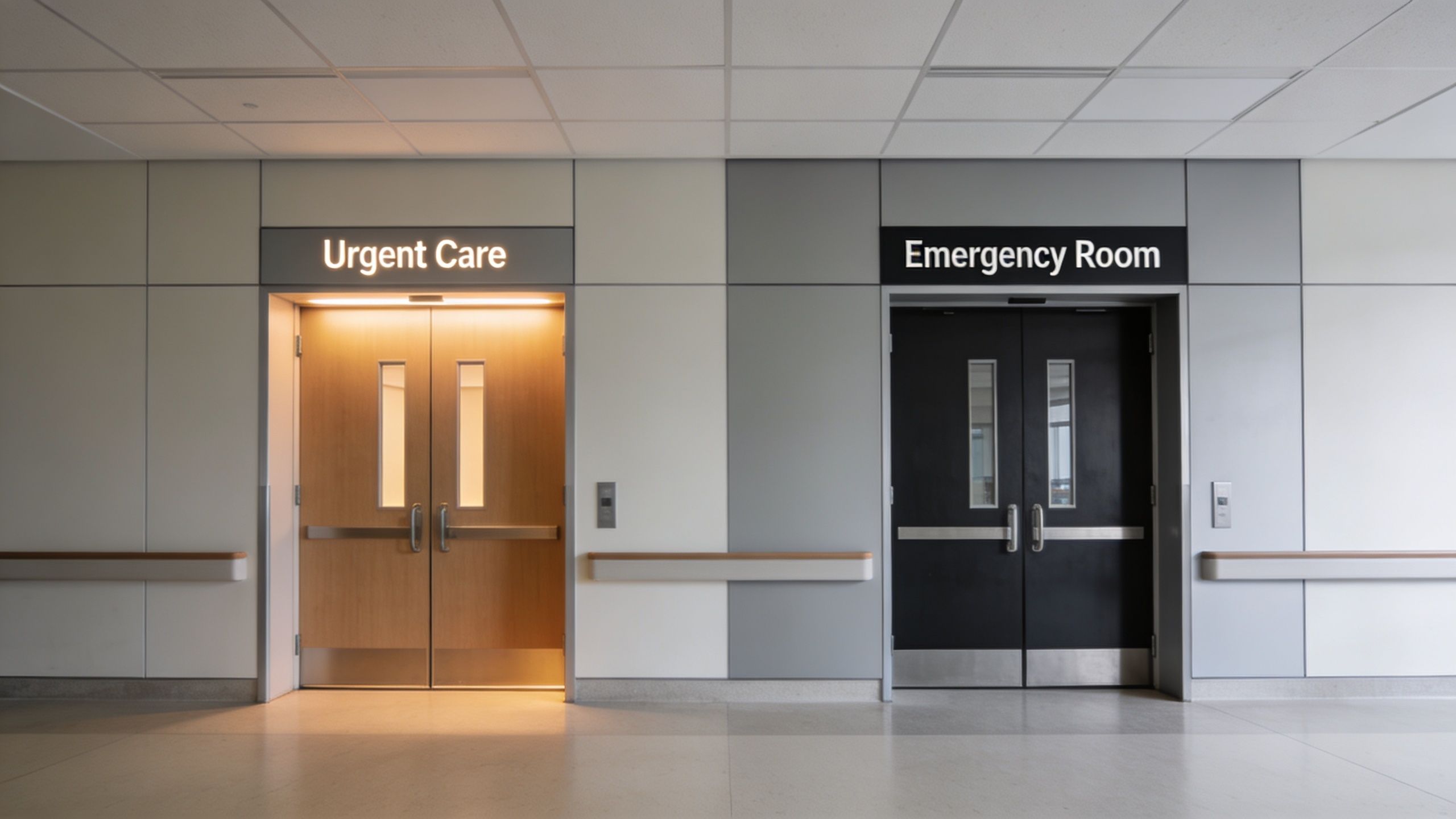
Urgent care and the emergency room are not competing versions of the same service. They are built for different risk levels, different equipment needs, and different speeds of escalation.
What urgent care is built to do
Urgent care fills the gap between primary care and the hospital. It exists for problems that shouldn't wait several days, but also don't require a trauma bay, advanced resuscitation, or full hospital resources.
That includes illnesses like flu symptoms, sinus infections, sore throat, pink eye, mild asthma symptoms, urinary symptoms, minor burns, simple lacerations, sprains, strains, and some fractures that need initial evaluation. Many urgent care centers can do on-site X-rays, basic lab work, swabs, wound repair, medication treatment, and short-term follow-up instructions.
For many patients, this is also the practical after-hours option when a primary care office is closed. If you want a clearer sense of how that role differs from office-based longitudinal care, this overview of the difference between urgent care and primary care is useful.
Urgent care is best when the question is, “I need to be seen today,” not “I might die if I wait.”
Urgent care is also narrower by design. That's a strength, not a weakness. By focusing on lower-acuity problems, the team can move quickly, use targeted testing, and avoid the delays that come with ER-level triage.
What the emergency room is built to do
The emergency room exists for unstable, high-risk, or potentially catastrophic problems. It has the staffing, monitoring, medications, imaging access, specialist backup, and hospital admission pathways needed for serious disease and injury.
If someone may be having a heart attack, stroke, internal bleeding, severe allergic reaction, major fracture, sepsis, or a surgical abdomen, urgent care is not the right endpoint. That patient may need rapid labs, continuous monitoring, advanced imaging, IV medications, procedures, or immediate specialist intervention.
Later in the encounter, the same illness can land in either setting depending on severity. A cough may belong in urgent care. A cough with blue lips, chest pain, confusion, or oxygen concerns belongs in the ER. A cut may belong in urgent care. A deep wound with pulsatile bleeding, tissue loss, or loss of hand function belongs in the ER.
A short visual can help reinforce that distinction:
Urgent Care vs Emergency Room at a Glance
When patients compare urgent care vs emergency room, they usually care about five things: severity, speed, cost, testing, and what happens if the visit gets more complicated.
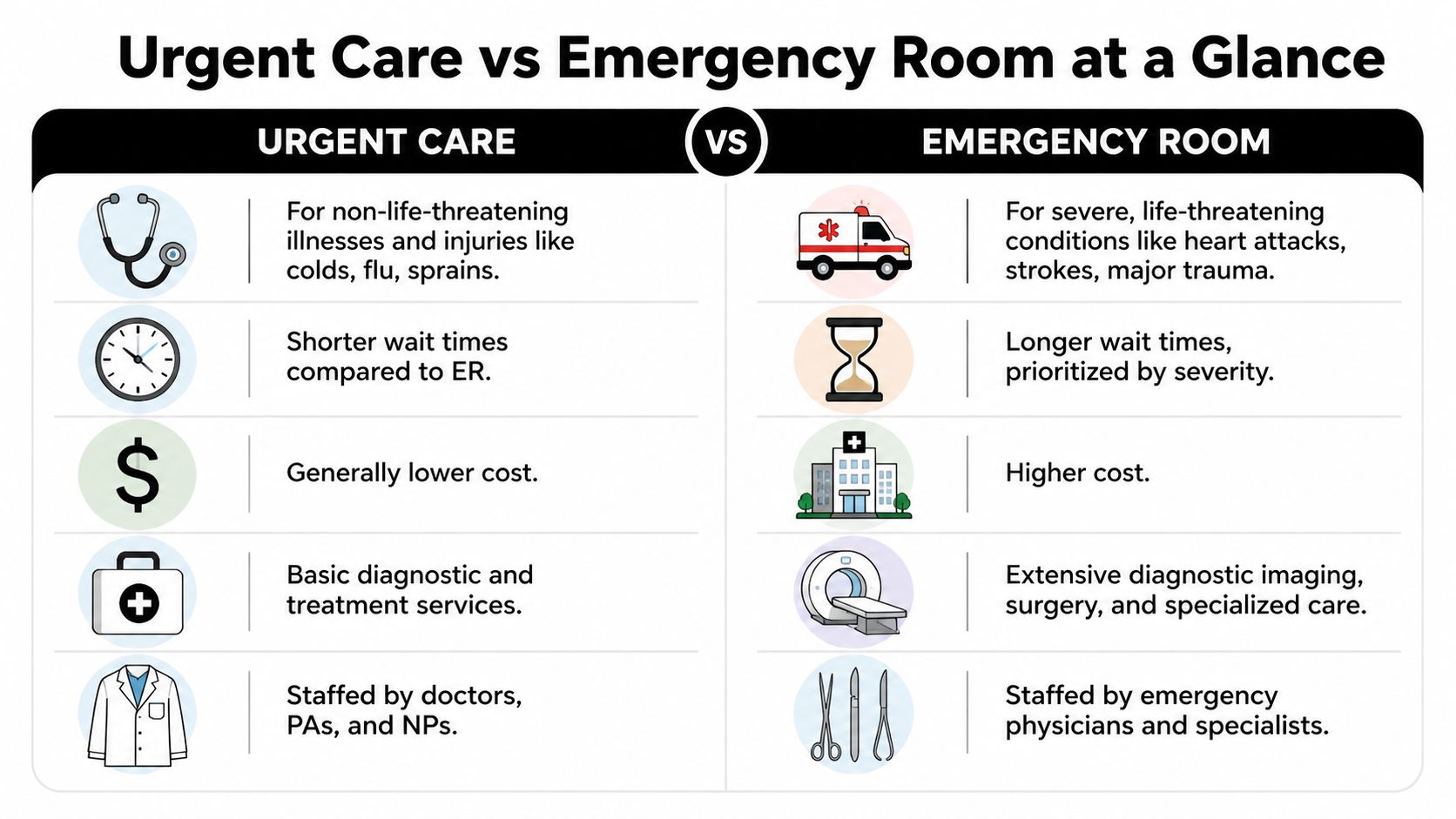
| Factor | Urgent Care | Emergency Room |
|---|---|---|
| Best for | Non-life-threatening illness or injury | Severe, life-threatening, or rapidly worsening conditions |
| Common examples | Colds, flu symptoms, minor cuts, rashes, sprains, ear pain | Chest pain, severe breathing trouble, stroke symptoms, major trauma |
| Wait pattern | Usually shorter for stable minor problems | Triage-based, so minor issues may wait longer |
| Cost pattern | Generally much lower | Generally much higher |
| Equipment | Basic diagnostics such as X-ray and lab testing | Advanced imaging, monitoring, procedures, specialists, admission access |
| Staffing | Physicians, PAs, NPs, support staff for lower-acuity care | Emergency physicians, hospital teams, specialists |
Two practical trade-offs matter most.
First, urgent care is efficient because it is selective. It works well when the problem is limited in scope and the patient is stable. The clinic can evaluate, test, treat, and discharge without the hospital's overhead.
Second, the ER accepts uncertainty at a much higher level. If the symptom could represent a dangerous diagnosis, the hospital environment is worth the longer wait and higher cost because the downside of missing something serious is much greater.
If your main question is “Could this turn bad quickly?” lean toward the ER. If your main question is “Can someone examine and treat this today?” urgent care often fits.
A common mistake is choosing based on pain alone. Severe pain deserves attention, but pain intensity doesn't always tell you which door is correct. A kidney stone, appendicitis, heart problem, fracture, or migraine can all present with major pain. What matters is the whole clinical picture, including location, duration, vital signs, injury mechanism, and associated symptoms.
When to Choose Urgent Care Common Scenarios
Urgent care is the right place for many same-day problems because it can handle focused evaluation without the delays of hospital triage. In one comparison, average urgent care wait times were 15 to 30 minutes, compared with 2 to 4 hours for non-emergency ER cases, as described in this review of urgent care and emergency room efficiency.
Minor illness that needs same-day treatment
You wake up with fever, sore throat, body aches, and fatigue. You're uncomfortable, but you're breathing normally, drinking fluids, and staying alert. That belongs in urgent care. The visit may include an exam, testing such as a throat swab, symptom relief, and guidance on whether you need medication or just supportive care.
The same applies to ear pain, sinus pressure, pink eye, urinary burning, mild rash, and coughs without red flags. These problems can feel miserable, but they usually don't require hospital infrastructure.
Injuries that are painful but stable
A twisted ankle after a weekend walk is a classic urgent care visit. So is a wrist injury after a fall, a finger jam, a minor burn, or a cut that may need stitches if the bleeding is controlled.
Urgent care works well when:
- You can move the area somewhat: It hurts, but the limb isn't grossly deformed or completely unusable.
- Bleeding is controllable: Direct pressure helps, and you're not soaking through bandages rapidly.
- You didn't lose consciousness: There isn't a major head injury concern that changes the risk level.
- You mainly need an exam and simple imaging: X-ray availability makes urgent care practical for many minor musculoskeletal problems.
If you're deciding whether a current problem fits that category, this page on when to visit urgent care gives a helpful overview of conditions commonly treated there.
Problems that need testing but not a hospital
Some visits are urgent because waiting several days is inconvenient or could prolong suffering, not because the condition is dangerous. A possible UTI, mild dehydration, a work-related minor injury, nausea without severe abdominal findings, or an asthma flare that is mild and responsive to usual medication may fit here.
Urgent care also helps when you need quick, practical services:
- Wound care: Cleaning, dressing, and deciding whether closure is needed.
- Basic imaging: Simple X-rays for suspected minor fractures or sprains.
- Point-of-care testing: Swabs, urine tests, and limited lab work.
- Medication starts: Antibiotics when indicated, inhaler support, pain management, and symptom relief.
A good urgent care visit is focused. The goal isn't to solve every long-term issue. It's to safely treat today's problem and tell you what needs follow-up.
What doesn't work well in urgent care is a problem that already looks unstable, rapidly progressive, or likely to need admission. That's where the ER changes from “more expensive” to “more appropriate.”
When to Choose the Emergency Room Red Flag Symptoms
The emergency room is the right choice when delay could cost you heart muscle, brain tissue, vision, organ function, or survival. This is the part of the urgent care vs emergency room decision where caution should win.
Symptoms that should send you straight to the ER
Go to the emergency room, or call emergency services, for any of the following:
- Chest pain or pressure: Especially if it's new, severe, associated with sweating, nausea, faintness, or pain moving into the arm, jaw, or back.
- Trouble breathing: Fast worsening shortness of breath, gasping, inability to speak full sentences, or bluish lips.
- Severe bleeding: Bleeding that doesn't stop with pressure, or bleeding that is heavy, spurting, or associated with weakness.
- Major injury: High-speed crash, fall with significant trauma, deep wound, major burn, or obvious deformity.
- Loss of consciousness or seizure: Even if the person seems better afterward, sudden collapse needs urgent evaluation.
- Severe allergic reaction: Swelling of the lips or tongue, wheezing, or trouble breathing.
- Sudden confusion or new neurological symptoms: Weakness, numbness, speech trouble, new vision loss, or severe imbalance.
- Severe abdominal pain with concerning features: Fainting, vomiting that won't stop, rigid abdomen, blood, or significant worsening.
Use the FAST rule for possible stroke
If you suspect stroke, remember FAST:
| Sign | What to look for |
|---|---|
| Face | One side droops |
| Arm | One arm drifts or feels weak |
| Speech | Words are slurred or hard to produce |
| Time | Time matters. Get emergency help now |
These symptoms are not “wait and see” problems. Even if they improve, the person still needs emergency evaluation.
Head injuries deserve the same seriousness when symptoms escalate. After a crash or fall, confusion, vomiting, severe headache, loss of consciousness, worsening drowsiness, or neurological changes push the visit out of urgent care territory. For readers trying to understand how hospitals evaluate brain injury after trauma, this resource on understanding TBI CT scan results provides useful context.
When uncertainty is a reason to escalate
Sometimes the safest choice isn't driven by one symptom. It's the combination. A person with diabetes who is vomiting, confused, and breathing hard. An older adult with weakness, fever, and a sudden decline. A patient with abdominal pain who looks pale and can't stand upright. Those patterns raise the level of concern.
When the symptom list is short but your concern is high, don't talk yourself out of the ER just because you're worried about “making a fuss.”
Urgent care can recognize emergencies, but it isn't the place to start if the danger signs are already obvious.
Your Local Choice for Urgent Care in Maryland
For stable, lower-acuity problems, local access changes behavior. If care is close, same-day, and straightforward to enter, patients are more likely to get treated early instead of waiting until a manageable problem becomes a hospital visit.
A major reason is cost. A 2021 study found the average urgent care visit cost $171 versus $1,646 for an ER visit, and the same analysis notes that urgent care's lower-acuity model offers a much lower-cost alternative for appropriate cases, as summarized by Penn LDI in its review of urgent care and emergency department spending. The same source also notes that telemedicine is becoming part of how clinics triage and manage non-life-threatening issues remotely.
Why local access changes decisions
In practice, the best urgent care option is one that reduces friction. Patients need walk-in access, same-day visits, straightforward follow-up, and on-site services that avoid sending them elsewhere for basic testing.
That matters in Prince George's County and nearby communities, where patients may be juggling work, transportation, family obligations, language barriers, or chronic conditions that flare outside routine office hours. A clinic with lab access, urgent visits, and telemedicine can close that gap for many non-emergency problems.
What to look for in a Maryland urgent care clinic
Look for a clinic that offers:
- Same-day access: So you don't postpone care until symptoms worsen.
- On-site diagnostics: Basic lab testing and imaging coordination make the visit more useful.
- Telemedicine options: Helpful for triage, follow-up, and stable problems that don't need immediate hands-on care.
- Clear escalation pathways: If your issue turns out to need hospital care, the team should tell you that directly and promptly.
One local option is Maryland Primary and Urgent Care advantages and services, which includes walk-in urgent care, same-day appointments, telemedicine, and on-site support services for adults in the Maryland area. For patients deciding where to go, those practical features matter more than slogans. They determine whether you can get evaluated quickly and whether the clinic can solve the problem in front of you.
Frequently Asked Questions About Urgent and Emergency Care
Can urgent care send me to the ER
Yes. That happens when the exam, vital signs, symptoms, or test results suggest you need a higher level of care. Good urgent care clinicians don't “miss” by referring you. They identify when the condition is outside the clinic's safe scope.
Examples include suspected appendicitis, chest pain that needs cardiac evaluation, major fractures, severe dehydration, stroke symptoms, or any patient who looks unstable during the visit.
Can urgent care help with a chronic condition flare
Often, yes. A flare is different from long-term management. If you have asthma symptoms, high blood pressure with mild symptoms, a diabetes-related concern, or worsening pain from a known condition, urgent care may be able to assess the immediate issue and decide whether you need medication adjustment, short-term treatment, close outpatient follow-up, or ER transfer.
What urgent care usually doesn't replace is your ongoing primary care plan. It handles the immediate problem, then hands the longer arc of management back to the appropriate clinician.
What should I bring
Bring what makes the visit safer and faster:
- Photo ID and insurance card: If you have them.
- Medication list: Include doses if possible.
- Allergy information: Especially drug allergies.
- A short symptom timeline: When it started, what changed, what makes it worse.
- Relevant records or photos: Rash photos, home test results, discharge papers, or previous imaging reports if you have them.
If the problem involves injury, be ready to explain exactly how it happened. Mechanism matters. Falling from standing is not the same as a high-speed crash.
What if I'm still not sure where to go
Use this rule. If you are deciding between urgent care and the ER and one of your options includes “this might be dangerous,” choose the ER. If the condition seems stable, localized, and treatable with an exam, simple testing, and outpatient treatment, urgent care is often appropriate.
You can also think in three questions:
- Am I in danger right now?
- Do I need hospital-level testing or monitoring?
- Would a few hours of delay likely make this much worse?
If the answer to any of those is yes, go to the ER.
The safest decisions are usually simple. Unstable symptoms go to the hospital. Stable symptoms that still need prompt care go to urgent care.
If you need same-day evaluation for a non-life-threatening illness or injury in Maryland, Maryland Primary and Urgent Care offers walk-in care, scheduled visits, and telemedicine to help patients get the right level of treatment without defaulting to the ER.