
If you’re searching for flu vaccine maryland, start with one useful fact. Maryland adults report stronger flu vaccination uptake than the national average, with 49.9% vaccinated in the past 12 months compared with 41.3% nationally, ranking the state 6th in the country according to America’s Health Rankings analysis of CDC BRFSS data. That tells me two things as a clinician. First, many Maryland residents already treat the flu shot as routine preventive care. Second, there’s still plenty of room to improve, especially for adults who are busy, managing chronic disease, or unsure where to go.
For most adults, the flu shot is simple. The harder part is fitting it into real life. People want to know which vaccine they need, whether it matters if they have diabetes or heart disease, where to get it without wasting time, and what happens if cost is a concern. Those are practical questions, and they deserve direct answers.
Table of Contents
- Your 2026 Guide to Flu Vaccination in Maryland
- How the Annual Flu Vaccine Protects You
- Who Is Recommended to Get a Flu Vaccine
- Finding Your Flu Shot in Maryland
- Flu Vaccine Costs and Insurance Coverage in Maryland
- Maryland Flu Vaccine FAQs and Checklist
Your 2026 Guide to Flu Vaccination in Maryland
Nearly half of Maryland adults report getting a flu vaccine in a typical season. That is a strong baseline, but it still leaves many people unprotected, especially those who are busiest, managing chronic illness, or trying to fit preventive care around work and family demands.
In clinic, the barriers are usually practical. Patients postpone the shot because they are not sure when to schedule it, whether insurance will cover it, or whether a pharmacy visit will address the rest of their health questions. Others feel well and assume they can wait until flu is already circulating in their workplace, school, or home.
Practical rule: Get vaccinated before flu starts disrupting your routine. Prevention is easier than catching up after exposure.
For adults with diabetes, high blood pressure, asthma, heart disease, autoimmune conditions, or a history of frequent respiratory illness, the flu shot is often part of a larger care plan, not a one-time errand. That is one reason an integrated clinic can be a better fit than a retail counter. If you need vaccine guidance, medication review, follow-up for symptoms, or help sorting out insurance and timing, those pieces can happen in one place at Maryland Primary and Urgent Care.
This guide focuses on the questions Maryland residents raise most often during visits:
- How the flu vaccine helps
- Who should make it a priority
- Where adults in Maryland usually go for vaccination
- How insurance, self-pay costs, and public programs affect access
- Why patients with more complex health needs may benefit from a primary care and urgent care setting instead of a quick stop elsewhere
How the Annual Flu Vaccine Protects You
The easiest way to understand the flu vaccine is to think of it as an annual software update for your immune system. Your body already knows how to fight infections. The vaccine helps it recognize the flu strains it’s most likely to face, so it can respond faster and more effectively.
That’s why the flu shot is annual. Influenza viruses change, and the vaccine is updated to match what public health experts expect to circulate. A shot from a prior season doesn’t give you the same level of current preparation.

Why it changes every year
Patients often ask, “If I got one before, why do I need another?” The short answer is that last year’s vaccine was built for last year’s problem. Flu viruses don’t stand still, and the immune system benefits from updated exposure.
This is one reason the shot is recommended as routine care rather than a one-time milestone. The goal isn’t just to check a box. The goal is to keep your protection aligned with the current season.
Getting vaccinated every year is less about repeating the same step and more about keeping your immune system current.
Which vaccine type might fit
Not every flu shot is identical. Maryland immunization guidance includes multiple formulations based on age and clinical context. Fluad® is approved for adults 65 and older, while Afluria® formulations can be used in patients starting at age 3, with dosing guided by prior vaccination history and ACIP recommendations, according to Maryland flu vaccine reference guidance.
That matters because good vaccination practice isn’t one-size-fits-all. A clinician should consider:
| Patient factor | Why it matters |
|---|---|
| Age | Some vaccine formulations are designed for older adults or specific age groups. |
| Vaccination history | Prior flu vaccination can affect dosing decisions in some patients. |
| Medical history | Chronic illness, allergy history, and prior vaccine reactions can guide selection. |
| Timing | A late vaccine is usually more useful than skipping it entirely. |
What works well is simple clinical matching. What doesn’t work is grabbing the first available option without considering age, health status, or whether you need anything else addressed during the same visit.
For healthy adults, the process is often straightforward. For older adults and people with more complicated medical histories, a clinical setting can make the decision clearer.
Who Is Recommended to Get a Flu Vaccine
The broad recommendation is simple. The CDC recommends annual flu vaccination for everyone age 6 months and older, with particular importance for people at higher risk, including those with heart disease or diabetes, and it can also fit alongside other required immunizations, including for immigration-related care, as noted by Shepherd’s Clinic vaccine guidance.

The general rule
If you’re an adult in Maryland and you haven’t had this season’s flu shot, you should assume it’s worth discussing unless you’ve been told otherwise by a clinician. An individual generally doesn’t need a complicated decision tree. They need a reminder that annual vaccination is standard preventive care.
For adults who tend to delay medical visits, this is one of the few interventions that can be done quickly and without a major workup. It’s low effort compared with the disruption that influenza can cause.
Who should make it a priority
Some groups shouldn’t put this off.
- Adults with diabetes: Illness can destabilize blood sugar and make recovery harder.
- Adults with heart disease or hypertension: Flu places stress on the body at exactly the time these patients need stability.
- Older adults: Age changes immune response and increases the importance of choosing the right formulation.
- Pregnant patients: Annual vaccination remains an important preventive step during pregnancy.
- Caregivers and people in frequent public contact: Vaccination helps reduce the chance of bringing flu home to more vulnerable family members.
For many adults, the flu shot isn’t separate from routine prevention. It belongs in the same conversation as blood pressure checks, diabetes follow-up, medication review, and preventive health screenings for adults.
When flu vaccination overlaps with other care
Some patients don’t fit the standard “healthy adult getting a quick shot” profile. They may be preparing for travel, catching up on vaccinations, or completing an immigration medical process. In those cases, the flu vaccine works best when it’s handled as part of coordinated care rather than an isolated retail transaction.
That’s particularly true when patients ask practical questions such as:
- Can I receive this with another vaccine?
- Will this fit my USCIS medical exam timing?
- Should I do anything differently because of my chronic condition?
Those are reasonable questions. What helps is a setting where someone can review the bigger picture. What usually doesn’t help is bouncing between multiple locations with no one responsible for follow-up.
Finding Your Flu Shot in Maryland
Access is where good intentions often break down. Maryland’s statewide performance is strong, but local availability still matters. County-level data show adult flu vaccination rates ranging from 16% to 36% in some areas, even while the statewide adult rate is 49.9%, according to the CDC FluVaxView dashboard. When local uptake is lower, convenience becomes part of prevention.
When to get vaccinated
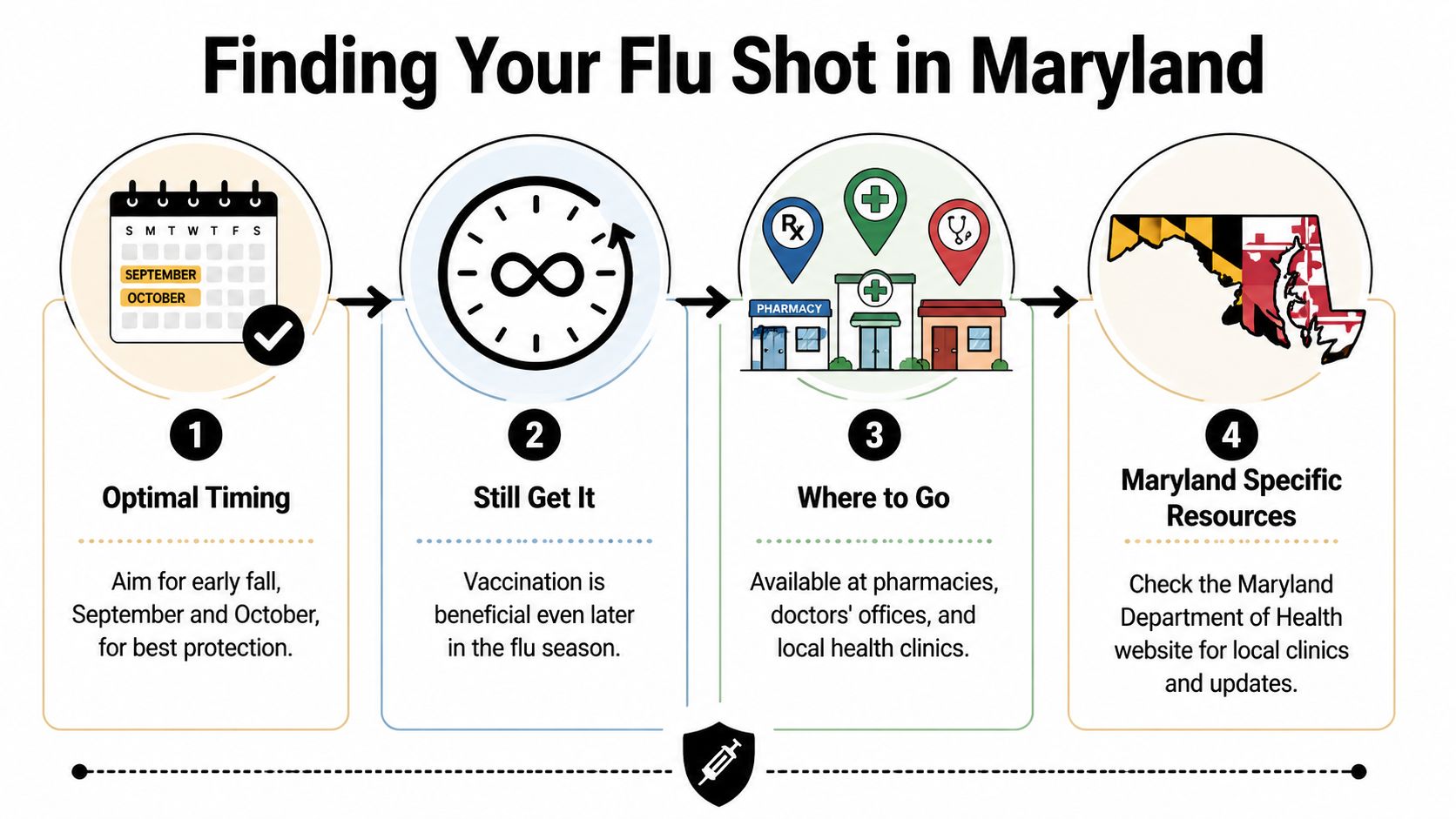
Most adults should aim for early fall rather than waiting until flu is already moving through workplaces, schools, and households. If you miss that window, it still makes sense to get vaccinated later rather than skipping the season entirely.
This visual summarizes the usual path.
Where adults usually go
Maryland adults generally have three practical options.
Pharmacies work well for speed and convenience. If you’re healthy, need a straightforward flu shot, and want evening or weekend access, a pharmacy is often enough.
Health departments matter for public access, especially for people looking for lower-cost or state-supported options. They’re important, but they may not be the best fit when you need medication review, chronic disease follow-up, or a broader visit.
Primary care or urgent care clinics make more sense when the vaccine is only one part of the visit. That includes adults with diabetes, hypertension, heart disease, recent illness, or questions about multiple vaccines.
A short explainer can help if you’re comparing options:
A practical comparison
| Location | Works well for | Trade-off |
|---|---|---|
| Pharmacy | Fast vaccination for generally healthy adults | Limited ability to handle broader medical questions |
| Health department | Public access and community vaccination programs | May not provide integrated chronic care follow-up |
| Primary or urgent care clinic | Vaccination plus evaluation, counseling, and follow-up | May require insurance review or appointment planning depending on the clinic |
For patients in Lanham and Prince George’s County, same-day doctor appointments near you can make the difference between “I’ll do it later” and getting it done.
There’s one more practical point. A clinic visit can solve more than one problem at once. Maryland Primary and Urgent Care offers flu vaccination along with walk-in care, same-day appointments, telemedicine, on-site labs, and broader follow-up for adults who need preventive care tied to chronic disease management, travel needs, or immigration-related services. That’s not necessary for everyone. It is useful when you don’t want your care split across multiple sites.
What works: choose the location that matches the complexity of your health needs.
What doesn’t: choosing only for speed, then realizing later no one addressed the rest of your care.
Flu Vaccine Costs and Insurance Coverage in Maryland
Cost worries stop a lot of patients before they even make the call. In many cases, that concern is larger than the actual barrier. If you have insurance, the flu shot is often handled as preventive care. The exact details still depend on your plan, where you receive the vaccine, and whether the visit includes anything beyond the shot itself.

What insured patients should expect
For insured adults, the most important question isn’t only “Is the vaccine covered?” It’s also:
- Was the vaccine given in-network
- Was it billed as preventive care
- Was there a separate office visit for other concerns
- Did the visit include additional services such as labs or evaluation
That’s why it helps to confirm coverage before you arrive, especially if you expect to discuss more than the shot itself. A visit that starts as vaccination-only can become a broader medical encounter if you also need chronic disease follow-up, symptom review, or another preventive service. If you want a quick primer on plan basics, this overview of health insurance options and coverage considerations is useful.
What the Maryland free adult vaccine program changes
Maryland has also expanded access for adults who might otherwise skip vaccination because of cost. Governor Moore’s free adult vaccine program, backed by $2.8M in funding, targets uninsured and underinsured Marylanders through local health departments, as outlined in the state program announcement.
That’s a meaningful step. It can reduce one of the biggest obstacles to adult vaccination. At the same time, patients should understand the trade-off. Public vaccine access and integrated private clinical care don’t serve the exact same purpose.
A health department option may be the right answer if your main need is vaccine access and you meet the program criteria. A private clinic may make more sense if you’re insured, need follow-up for diabetes or hypertension, want a same-day medical evaluation, or need multiple services coordinated in one visit.
Why billing and follow-up still matter
Patients sometimes assume vaccine billing is always simple. It often is. But when a visit includes administration plus counseling, records, or additional care, correct coding and claim handling become more important. Office teams, billers, and practice administrators who want a technical overview can review this guide for vaccine administration claims, which explains how administration coding is handled in a medical billing context.
Billing tip: ask two questions before your visit. “Is the vaccine covered at this location?” and “Will anything else discussed today create a separate office visit charge?”
That small step prevents most surprises. It also helps you choose the right setting. If you just need the shot, a simple vaccination visit may be enough. If you need the shot plus real clinical follow-up, paying attention to coverage and visit type is worth it.
Maryland Flu Vaccine FAQs and Checklist
A few questions come up every season, even after patients understand the basics. Here are the answers I give most often.
FAQ
Can the flu shot give me the flu?
No. People may notice short-lived soreness, fatigue, or a mild achy feeling afterward, but that isn’t the same as influenza infection.
What side effects are most common?
Most side effects are mild and temporary. Soreness at the injection site is the one patients mention most often. Some people also feel tired or slightly run down for a short time. Severe reactions are uncommon, but you should contact a clinician promptly if something feels out of proportion.
Is it still worth getting the shot if I’m healthy?
Yes. Healthy adults can still get quite sick with flu, miss work, and spread infection to older relatives, pregnant family members, or people with chronic illness.
What if I have an egg allergy?
That’s a question to raise before vaccination, not a reason to assume you can’t be vaccinated. The right approach depends on your history and the product being considered.
Can I get the flu shot if I’m also handling USCIS medical paperwork or other vaccines?
Often yes. Coordination matters more than guessing. If your care involves immigration requirements, travel vaccines, or multiple preventive services, it’s better to confirm timing in advance.
If I got the flu shot and still get sick later, did it fail?
Not necessarily. Vaccination is meant to reduce risk and improve your odds going into flu season. It remains a useful preventive step even when it doesn’t prevent every illness.
If you’re unsure because of allergies, chronic disease, pregnancy, or timing with other vaccines, ask before delaying. Most concerns can be sorted out quickly.
Your flu shot checklist
Use this short list to move from reading to action.
- Pick your setting: pharmacy for a quick shot, health department for public access, or a clinic if you need broader care.
- Check your coverage or eligibility: confirm insurance details or ask whether you qualify for a public vaccine program.
- Bring the right information: insurance card, medication list, and any questions about chronic conditions, travel, or immigration requirements.
- Don’t split care unless you have to: if you know you need follow-up, choose a setting that can handle more than vaccination alone.
Getting a flu shot shouldn’t become a complicated project. It should be one completed piece of preventive care.
If you’re ready to schedule flu vaccination with follow-up care in one place, Maryland Primary and Urgent Care provides adult primary care, walk-in urgent care, same-day appointments, telemedicine, on-site labs, and a full immunization portfolio for patients in Lanham and across the surrounding area.