
https://mdicare.com/immigration-vaccines-for-green-card/
If you're getting ready for your green card medical exam, the vaccine part is where many avoidable delays happen. The good news is that immigration vaccines for green card cases are manageable when you know what records to bring, which vaccines count for your age, and when a civil surgeon can document that a vaccine isn't medically appropriate.
Applicants often arrive with a folder full of paperwork but no clear idea whether their vaccine history is enough. That uncertainty matters. According to USCIS FY2025 green card vaccine requirement reporting, approximately 12% of adjustment of status denials were medical-related, with vaccination issues as the primary cause. Most of those problems can be prevented before Form I-693 is sealed.
Table of Contents
- Your Green Card Medical Exam and Vaccine Requirements
- USCIS Required Vaccines by Age Group for 2026
- How to Prove Your Vaccination Status
- Understanding Vaccine Waivers and Medical Exemptions
- Preparing for Your Civil Surgeon Medical Exam
- Your Next Steps at Maryland Primary and Urgent Care
- Frequently Asked Questions About Green Card Vaccines
Your Green Card Medical Exam and Vaccine Requirements
The vaccine review is not a side issue in the immigration medical exam. It is one of the core parts of Form I-693.
A civil surgeon does not merely ask whether you've had shots before. The civil surgeon must review your records, decide whether the required vaccines apply to your age, determine whether immunity proof is acceptable, and document the result correctly on the immigration form.
What the exam is really checking
For immigration vaccines for green card applications, the question is not just "Are you vaccinated?" The critical aspect is whether you can prove compliance under the CDC and USCIS rules used in the medical exam.
That usually means one of these outcomes:
- You already have acceptable records
- You need one or more vaccines now
- You need blood testing to prove immunity
- A vaccine isn't medically appropriate and must be documented correctly
Each outcome can still lead to a completed I-693 if it is handled properly.
Bring every vaccine document you have, even if it looks old, foreign, or incomplete. A partial record is often more useful than no record at all.
Why applicants get delayed
Most delays come from practical mistakes, not rare legal problems.
Common examples include:
- Missing childhood records that were never transferred from a prior doctor
- Foreign records without translation
- Assuming prior illness is enough without documentation when proof is required
- Waiting too long to start a catch-up vaccine series
- Confusing a medical exemption with a personal preference
The process becomes much easier when you treat the vaccine review like document preparation, not just a clinic visit.
What to do before your appointment
Start with a simple checklist:
- Gather your vaccine records from doctors, schools, pharmacies, or public health agencies.
- Separate records in English from records that need translation.
- List any history of allergies, immunocompromising conditions, pregnancy, or prior severe vaccine reactions.
- If records are missing, be ready to discuss titers or catch-up vaccination.
- Book your exam early enough to avoid last-minute scrambling.
A well-prepared applicant usually doesn't need multiple rounds of follow-up. That is the goal.
USCIS Required Vaccines by Age Group for 2026
The CDC uses an age-based framework. A vaccine may be required for one applicant and not required for another because the age category is different.
For practical purposes, the clearest way to understand immigration vaccines for green card cases is to look at them by age group.
Required vaccines by age
The CDC's age-based vaccine chart effective March 11, 2025 is the working framework civil surgeons use for immigration exams, including categories such as hepatitis B for the youngest applicants, expanded childhood vaccines for infants and children, and adult requirements that can include Tdap or Td, MMR if immunity isn't shown, varicella, IPV, hepatitis B, meningococcal, pneumococcal vaccines, influenza when seasonally required, and zoster for older adults, as listed in the CDC vaccine requirements according to applicant age table.
| Age Group | Required Vaccines |
|---|---|
| Birth to 1 month | Hepatitis B |
| 2 to 11 months | DTP/DTaP/DT, IPV, Hib, Hepatitis B, rotavirus, pneumococcal |
| 12 months to 6 years | DTaP/DT, IPV, Hib, Hepatitis B, rotavirus if age-appropriate, pneumococcal, MMR, varicella, Hepatitis A |
| 7 to 10 years | DTaP, IPV, MMR, varicella |
| 11 to 17 years | Tdap, meningococcal, pneumococcal where applicable |
| 18 to 64 years | Tdap/Td, MMR if no immunity, varicella, IPV, Hepatitis B, meningococcal, pneumococcal, influenza when seasonally required |
| 65 years and older | Tdap/Td, MMR if applicable, varicella if applicable, pneumococcal, influenza high-dose, zoster |
The vaccines adults most often ask about
Most adult applicants ask about the same core vaccines.
- MMR matters if you do not have proof of immunity. If you need background on this vaccine locally, this MMR in Maryland guide is a useful starting point.
- Varicella can often be addressed through records, immunity testing, or a documented history when accepted by the examining physician.
- Tdap or Td is a routine issue because many adults know they had a tetanus shot at some point but don't have the record.
- Hepatitis B frequently becomes relevant for adult applicants in the covered age range.
- Influenza depends on season and medical appropriateness.
What changed with COVID-19
One major policy point is settled. COVID-19 vaccination was removed from immigration vaccine requirements on March 11, 2025, as reflected in the CDC framework cited above.
That means applicants should focus on the vaccines that still appear on the current immigration schedule. I still see applicants arrive worried about an outdated COVID rule while missing a basic record for MMR or Tdap. Those older concerns can distract from the items that still control the I-693 review.
The most efficient approach is simple. Match your records to your age group first, then solve the missing pieces.
How to Prove Your Vaccination Status
Having the vaccine is only half the job. You must show proof the civil surgeon can use on Form I-693.
What counts as acceptable proof
The strongest evidence is an official vaccination record from a physician, clinic, pharmacy, school health system, or public health authority. Records should clearly identify you and show the vaccine name and administration date.
Useful documents often include:
- Doctor or clinic printouts
- Pharmacy immunization records
- Childhood vaccine cards
- School or public health records
- Prior immigration medical paperwork, if it contains usable vaccine details
If you're missing records, ask prior providers for copies before your exam. A structured request can help. If you need to organize that request, a HIPAA-compliant medical record release form can make it easier to collect records from different providers.
When blood titers help
A titer is a blood test that shows immunity. For some vaccines, a positive antibody result can serve as proof when old records are missing.
Titers are commonly used when an applicant believes they were vaccinated years ago but can't locate the paperwork, or when they had a disease in the past and need laboratory proof of immunity.
Practical situations where titers may help:
- Old childhood vaccines with no records
- Foreign vaccination histories that are incomplete
- Applicants who want to avoid repeating certain vaccines when immunity can be shown
A titer doesn't replace every vaccine question, but it can solve several common documentation gaps.
Foreign language records
Records in another language can still be useful, but they need to be understandable and reliable for the immigration file.
If your vaccine record is not in English, bring a certified English translation with it. The original document and the translation should travel together.
That one step prevents many avoidable follow-up requests.
What not to rely on
Applicants often bring items that don't settle the issue on their own.
Avoid assuming these will be enough:
- Memory alone
- A verbal statement that you had the disease
- A photo of a record with missing dates
- An incomplete translation
- A family member's summary of what vaccines you probably received
If the record is weak, the cleanest solution is usually either a titer or getting the needed vaccine during the medical process.
Understanding Vaccine Waivers and Medical Exemptions
At this stage, applicants often confuse two very different paths. One is medical. The other is discretionary and much harder.
When a vaccine is not medically appropriate
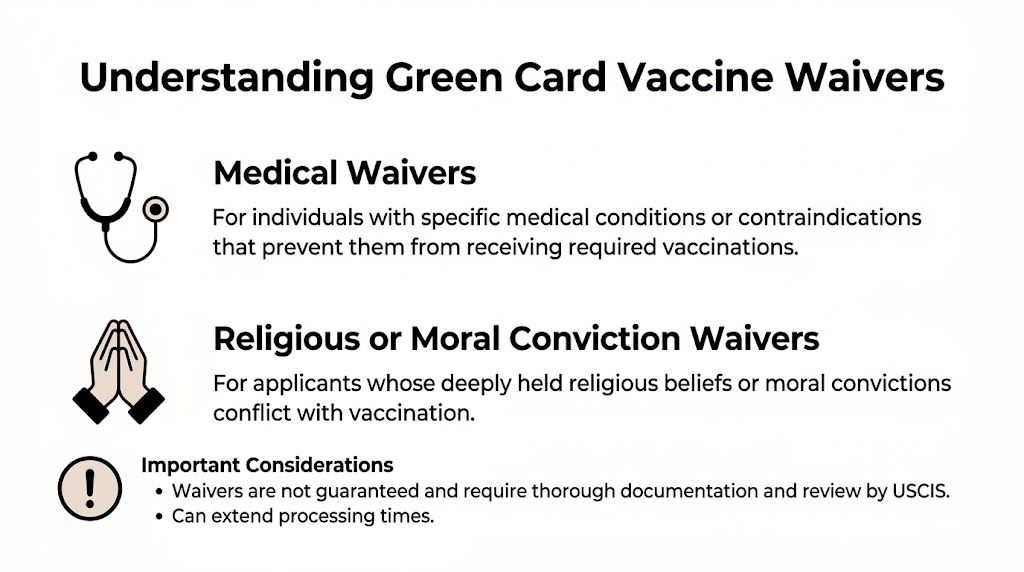
A civil surgeon can document that a vaccine is not medically appropriate when the applicant has a valid medical reason not to receive it. That may involve a contraindication such as allergy, immunocompromise, or another clinical reason that makes the vaccine inappropriate at that time.
According to the CDC's civil surgeon guidance, government agencies are instructed to accept a civil surgeon's assessment that a vaccine is not medically appropriate unless that finding is clearly wrong, as stated in the CDC civil surgeon vaccination instructions.
That point matters. A properly documented medical assessment carries real weight in the immigration process.
Religious or moral waivers are different
A religious or moral conviction waiver is not handled the same way. This path generally requires a separate filing and careful legal support because the applicant must show a sincere objection to all vaccines, not selective disagreement with only one or two.
The standard is demanding. Prior vaccine history can create additional scrutiny because officers may ask whether the objection is consistent.
Here is the practical contrast that applicants need to understand. Medical waivers documented by a civil surgeon as not medically appropriate have a near-automatic approval rate of over 90%, while religious or moral waivers filed on Form I-601 have denial rates as high as 60 to 70%, according to the waiver discussion summarized in this 2024 USCIS waiver analysis video.
What tends to work and what doesn't
The strongest medical exemption cases are clinically straightforward and well documented. The weakest religious or moral cases are selective, last-minute, or framed as personal preference.
A useful comparison:
| Path | What usually helps | What usually hurts |
|---|---|---|
| Medical exemption | Clear contraindication, complete clinical history, correct I-693 notation | Vague symptoms, no supporting history, asking for exemption out of convenience |
| Religious or moral waiver | Consistent objection to all vaccines, coherent supporting documentation, legal preparation | Selective objections, prior inconsistent conduct, filing without a clear evidentiary strategy |
A medical exemption is a clinical judgment. A religious or moral waiver is a separate legal request. Treating them as interchangeable is a common mistake.
Preparing for Your Civil Surgeon Medical Exam
The appointment runs more smoothly when you arrive with the right documents and realistic expectations.
What to bring to the appointment
Bring originals when possible, plus copies you can leave behind if the clinic requests them.
Your checklist should include:
- Government-issued photo ID such as a passport or other accepted identification
- Vaccination records from any country or provider
- Certified translations for non-English records
- Any prior lab evidence of immunity
- Your medical history details, especially allergies, pregnancy status, immune conditions, or prior severe reactions
- Form I-693 information, if the clinic asks you to complete your portion in advance
Refugee adjustment cases may involve identity review tied to Form I-94. Identity verification is part of the formal protocol, not a clerical detail.
What the civil surgeon actually does
The civil surgeon's role is specific. It includes reviewing vaccine records, deciding whether each listed vaccine is age-appropriate or medically appropriate, recording the result on Form I-693, and determining whether additional vaccination or laboratory proof is needed.
That is why small details matter. A vaccine date, a name mismatch, or an untranslated record can change whether the form can be completed that day.
For a broader overview of finding the right doctor for this process, this guide to the USCIS immigration process and finding a civil surgeon near you may help.
What happens if records are incomplete
Incomplete records don't automatically stop the exam. They change the next step.
That next step may be:
- Receiving a needed vaccine
- Completing a titer
- Having the civil surgeon document a medical reason a vaccine isn't appropriate
- Returning with an additional record
A short explainer can help you visualize how the visit typically unfolds.
The sealed envelope rule
After the medical exam is completed, the I-693 is usually provided in a sealed envelope for submission to USCIS. Do not open it.
If you break the seal, USCIS may reject the medical packet and require a replacement. That creates an unnecessary delay and may require another visit.
Keep the sealed packet exactly as you received it. Submit it as instructed, unopened and undamaged.
Your Next Steps at Maryland Primary and Urgent Care
If you're in Lanham or nearby areas and want a single location for the immigration medical process, a practical next step is scheduling with a clinic that handles vaccine review, lab work, and Form I-693 completion together.
At Maryland Primary and Urgent Care's immigration medical exam service, applicants can complete the civil surgeon exam with on-site support for record review, titers when needed, and required immunizations that are available through the clinic's immunization services. That matters when your records are incomplete and you want to avoid bouncing between multiple offices.
This type of setup is especially useful for applicants who need one of the following:
- A same-visit vaccine review with a decision on what still needs to be addressed
- On-site lab testing if immunity proof is a better fit than repeating vaccines
- Civil surgeon documentation when a vaccine may not be medically appropriate
- Coordinated paperwork handling so Form I-693 is completed accurately and sealed correctly
Dr. Sherif Hassan serves as a designated USCIS civil surgeon, and the clinic's scope includes immigration medical exams along with routine adult care and immunization services. If you're trying to keep the process simple, call ahead, ask what documents to bring, and book early enough that missing records or extra vaccines won't put your filing timeline under pressure.
Frequently Asked Questions About Green Card Vaccines
What if I lost all my vaccine records
Start by requesting records from prior doctors, pharmacies, schools, or health departments. If records still can't be found, a civil surgeon may use titers for some vaccines or give needed catch-up vaccines when appropriate.
Can I use vaccine records from another country
Yes, if the records are reliable and readable. If they are not in English, bring the original plus a certified English translation.
Do I need every vaccine dose finished before the exam
Not always in the way applicants assume. The civil surgeon evaluates what is age-appropriate and medically appropriate at the time of the exam and records the result on Form I-693. If a series requires follow-up doses over time, the first required step and proper documentation are what matter most at the visit.
How much will the exam or vaccines cost
Costs vary by clinic, by which vaccines you still need, and by whether titers or other testing are required. Ask for a written breakdown before the appointment so you know whether the quoted fee includes the exam only or also includes vaccines and lab work.
How long is Form I-693 valid
USCIS validity rules can change, and timing matters in relation to when the civil surgeon signs the form and when you submit it. The safest approach is to submit the sealed I-693 promptly and confirm current timing rules when you schedule.
If you need a civil surgeon appointment, vaccine review, or help completing Form I-693 without avoidable delays, Maryland Primary and Urgent Care provides immigration medical exams, on-site testing, and vaccination support for green card applicants in Lanham and surrounding communities.